Oil Soars After Iran Strikes: Are More Gains to Come in Energy?

Key Takeaways
- Geopolitical tensions sparked a sharp 7–8% surge in WTI and Brent crude to begin March.
- A confirmed technical breakout and rising 200-day moving average suggest the bullish trend remains intact despite near-term resistance.
- Energy stocks continue to outperform the broader market as volatility spikes across the commodity complex.
First Venezuela, now Iran. U.S. and Israeli-led strikes on the oil-producing country over the weekend sent WTI ($WTIC) and Brent ($BRENT) crude soaring to begin March. U.S. oil jumped 7% to $72, while a barrel of Brent climbed 8% to $79.
Importantly, from a geopolitical standpoint, the $BRENT–$WTIC spread widened to more than $7 (it had been about $3 last year during calmer times).
Oil’s Rally Is Nothing New
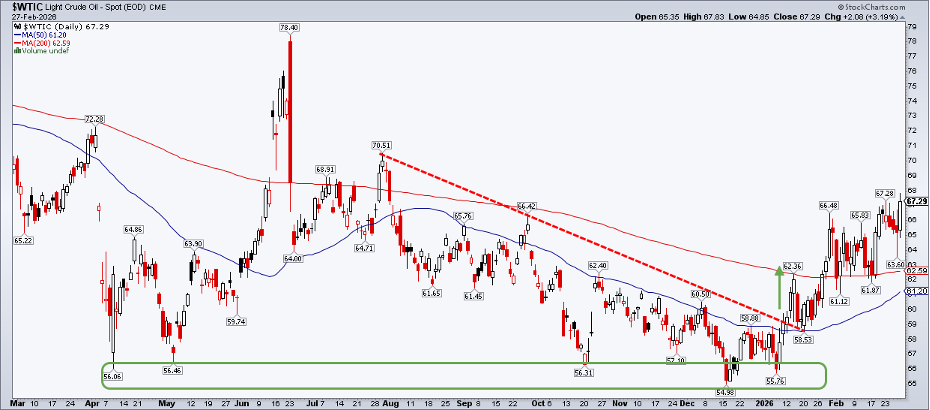
But black gold has been on the rise for a while now. WTI bottomed in mid-December under $55, notching a multi-year low amid President Trump’s push for cheap domestic energy prices. A slick move above its 50-day moving average in January, then above the 200-day moving average just a few weeks later, suggested the bulls had grabbed control of the trend. Today, $WTIC is at its best level since the U.S. hit key Iranian nuclear facilities in June 2025.
The big question is: Where does oil go from here?
The Charts Tell the Tale
As always, it pays to take off our macro strategist hat and put on our technician cap. Notice in the chart below that oil broke out from a downtrend pattern earlier this year. That was the cue to consider either getting long an oil ETF (such as the United States Oil Fund (USO)) or simply going overweight Energy equities.
It was becoming clear at the time that the mid-$50s were crucial support. Despite the bearish rhetoric from the White House and all the chatter of a supply glut in the oil patch, WTI kept ascending.
Near-Term Selling Pressure?
Zooming out, we find that resistance may now be in play, after a 30% thrust in less than three months. The rolling prompt-month contract gapped up to the mid-$70s on Sunday night, but it then retreated to the low $70s. This range is the new battle zone.
What’s more, the Oil Volatility Index has soared, so a price breakout or breakdown could come in short order. On the price chart, a downtrend resistance line off the Q3 2023 high has been hit after one of WTI’s best days in the past five years.
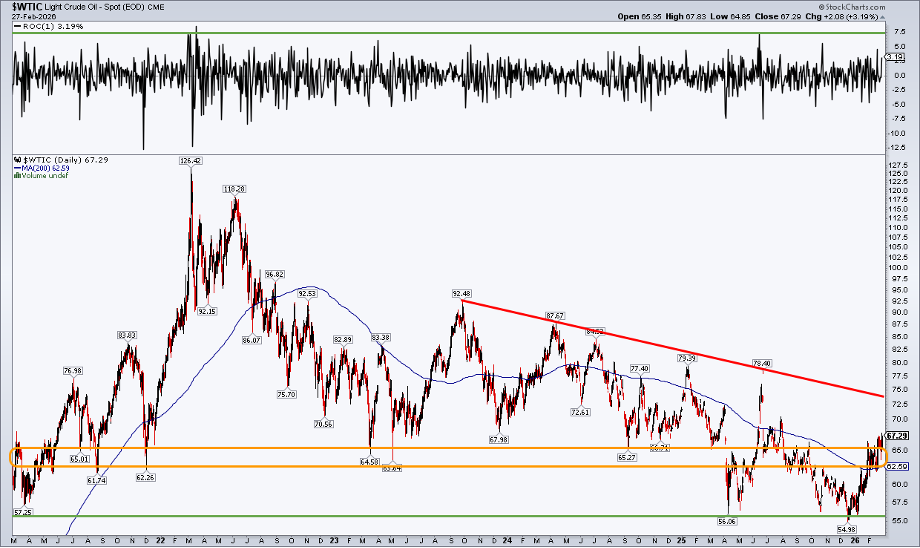
Also, take a look at the 200dma. It’s on the rise, suggesting that the bulls control the primary trend. While nothing like the upside momentum seen half a decade ago (when Brent hit $135), oil longs have some bullish factors to work with. Along with the 200dma inching up, upcoming calendar trends are sanguine.
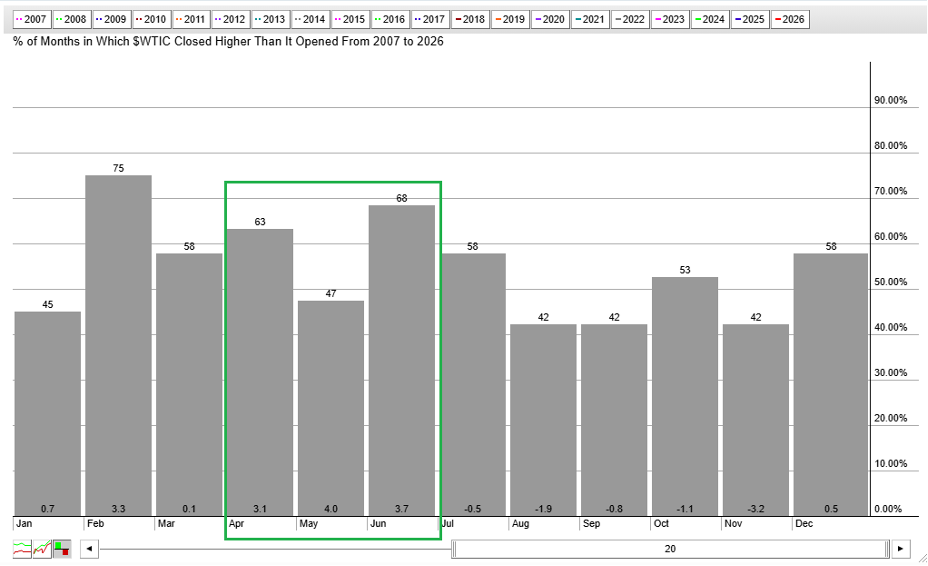
Meh March, Active April-June?
StockCharts seasonality data reveal that though March has been a so-so month in the past two decades, solid gains have been made in Q2. The April-through-June stretch is easily the strongest three-month period.
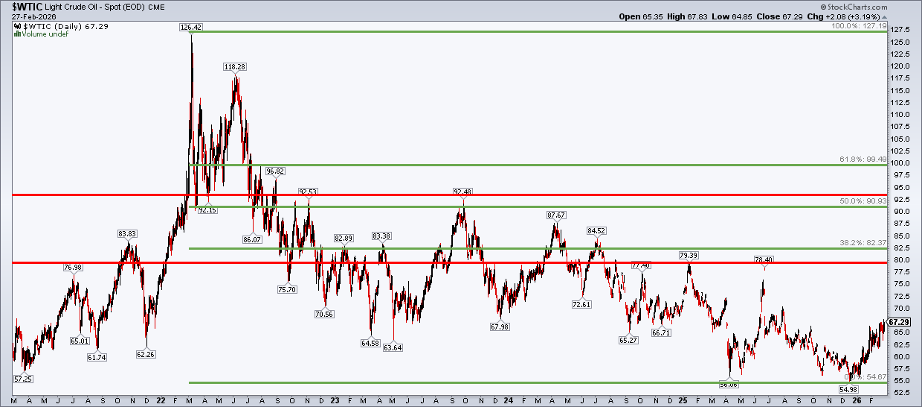
On the chart below, a rally through the low $70s points to a next stop in the $77 to $80 zone (the peaks from Q3 2024 to last June). Above there, $92–$93 can’t be ruled out.
Fibonacci aficionados may eye the 38.2% retracement of the March 2022 high to the December 2025 low. That enters the picture at just above $82. The 61.8% Fibo level is pennies below $100.
XOM & XLE Decidedly Bullish
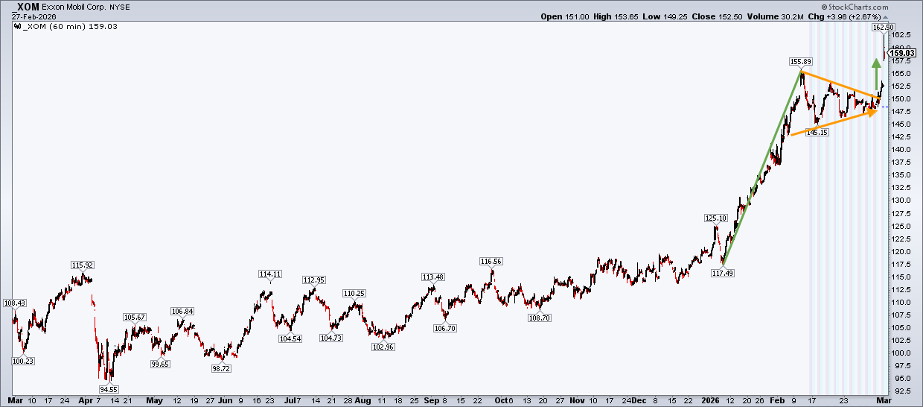
Another way to play relative strength and absolute momentum in energy commodities is through Energy stocks. There, my go-to is Exxon Mobil (XOM). In December, I noted that $155 was doable based on emerging chart patterns. It got there quickly, topping near $157 before pulling back to $145. Before the weekend’s geopolitical events, a daily bull flag pattern looked to be breaking in the bulls’ favor.
While not a perfect view, the “Extended Hours” toggle on SharpCharts is useful for gauging more granular after-hours and pre-market action. That perspective helps, as it illustrates how the series of lower highs and higher lows set up for a breakout (in the trend of a larger degree). XOM gapped from $152.50 to $160 on Monday.
A new measured-move upside price objective to $188 is active, taken from the height of the January–February thrust and added onto the $150 coil breakout. Of course, a gap now lingers on the chart just above $150. Chances are it will be filled if WTI pauses at the noted downtrend resistance line.
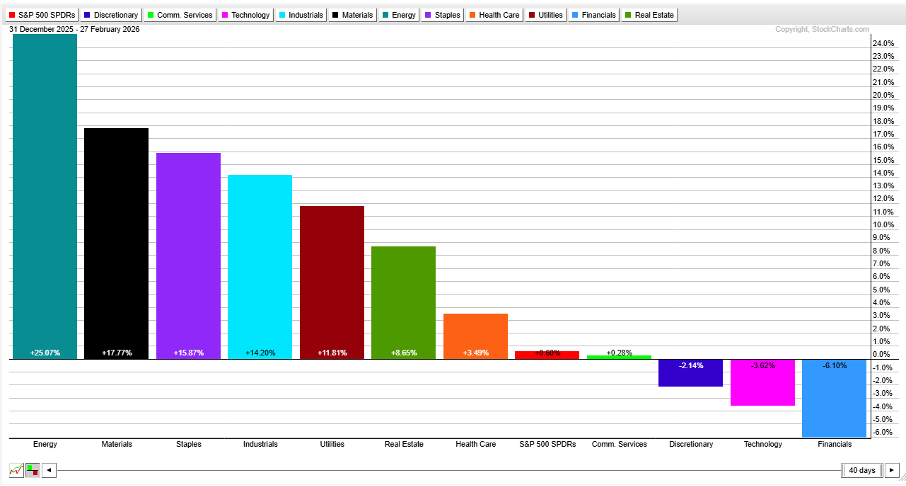
More broadly, Energy now leads the 10 other S&P 500 sectors by a wide margin. It was +24.4% YTD through February.
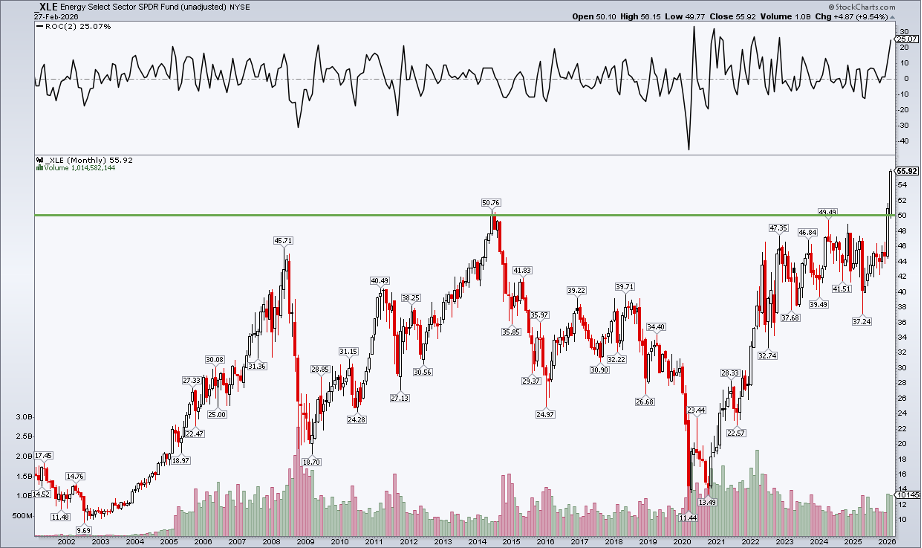
The Energy Select Sector SPDR ETF (XLE) returned 25% in the year’s first two months, the best back-to-back stretch since October–November 2022 (coming off the bear market low).
Like its largest component (XOM), the bulls appear in charge with XLE. The monthly chart shows that once $50–$51 was cleared, it was off to the races. A long-term target in the low $90s is doable, based on the depth of the 2014–2020 drop, the subsequent rally to $50, and the early-2026 climb to new highs.
XLE may make a run at its best quarterly performance on record, depending on how March unfolds.
The Bottom Line
Traders’ eyes were glued to futures screens at 6 p.m. ET on Sunday. Brent gapped up 13%, and WTI briefly rose to near $75. Initial profit-taking kept a lid on the energy complex, but volatility remains extremely high. U.S. oil is encountering near-term resistance, but Energy equities look strong on longer-term charts.
Disclaimer: This blog is for educational purposes only and should not be construed as financial advice. The ideas and strategies should never be used without first assessing your own personal and financial situation, or without consulting a financial professional.