StockCharts Insider: 12 Reasons Alerts Transform Your Market Performance
Before We Dive In…
Many traders who think they have a charting problem actually have more of an attention problem, or even a timing problem. You can have the best chart and indicator setup, but if you still have to check your charts intermittently, you’re operating on a delay. Worst-case scenario, you’re doing things hit-or-miss.
You know the market won’t wait for you to click on your watchlist. And that’s why Alerts were invented. It’s a simple thing, it seems. But when used correctly, alerts can transform how you interact with the market, and all the (missed) opportunities that come with it.
The Big Idea: Alerts = Control
This is not a “how to” post, so I’m not going to show you all the ways to work the Advanced Alert Workbench. That’s what our Technical Alerts support page is for (and you’ll want to check it out after reading this).
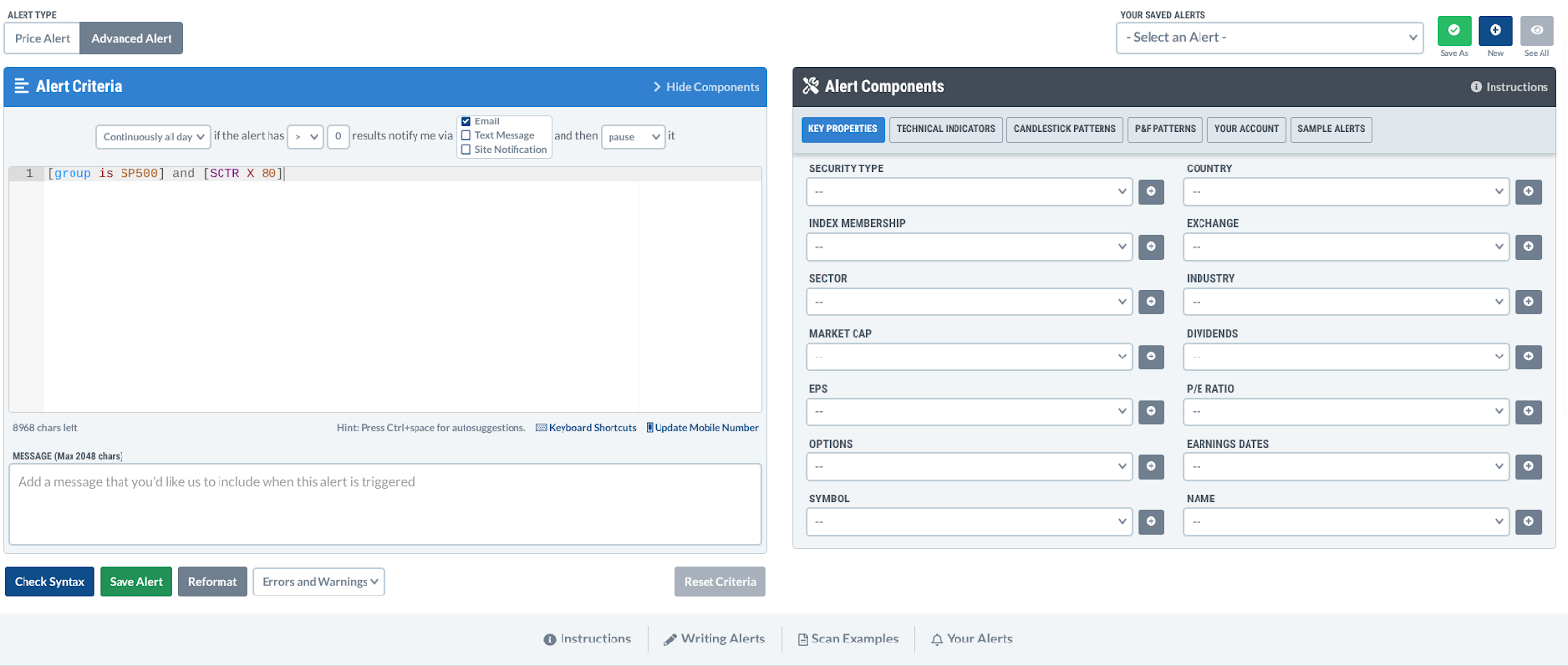
This short article proposes 12 use cases for alerts, plus a few insider tips. Overall, alerts give you control over three things:
- Time: You don’t have to check your charts constantly throughout the day.
- Attention: You can focus only on what matters.
- Execution: You don’t jump the gun or miss the boat; you act when all your criteria are met.
Now, let’s delve into the nitty gritty.
12 Reasons Why You Should Use Alerts
1 - You stop missing high-probability setups
Breakouts, reversals, and key indicator triggers can happen while you’re not watching. This is where you can easily miss opportunities, especially when you’re at work.
It may seem like a simple thing, but missing a trade can make a big difference, especially if the trade turns out to be a big winner. Using alerts, alone, can significantly change your results.
2 - You reclaim hours of screen time
A thought experiment: Say you’re 20 years old, and you watch the market 3 hours each day up until the age of 60. By then, you’ll have accumulated 10,400 days watching charts. That’s 8 full working years (40 hours a week).
It’s a time drain. Why do this when alerts can scan the markets for you continuously? This is pure time leverage, and you should use it.
3 - You “pull the trigger” only when your criteria are met
Entering a position early or speculating on a trade that you haven’t thought through tends not to work out too well in the big scheme of things. Instead, it’s probably better to operate like this: “If x happens, I pull the trigger. If not, I ignore it.”
Alerts signal you when it’s time to act. Any other deviation may not always work in your favor. If it did, you’d probably have worked that into your system, which means, you should set an alert for it.
4 - You enforce and eventually acquire discipline automatically
There’s a psychological effect to following #3 above. You train yourself to avoid making impulse trades, reacting to headlines (unless the conditions are baked into your strategy), or chasing random setups.
5 - You offload mental work
You can be a disciplined professional (in whatever you do), but given today’s multi-tasking pressures, you’re likely to forget stuff. If you use alerts, there’s no need to remember what to watch. No more mental checklists, forgotten setups, or scattered attention. Your criteria is in the system, not in your head. Why compromise focus because of stress?
6 - Your strategy virtually runs when you’re not watching
It may not be the same as running an automated strategy which buys and sells when you’re not watching, but, believe me, this has gotten many traders into a lot of trouble. You want control over execution. Alerts can bridge that gap. In other words, your market opportunities won’t shut off when you log off.
7 - It completes your workflow
Many traders tend to stop here:
- Charts 🠊 Scans 🠊… (background noise, or birds)
Here’s what it should look like:
- Charts 🠊 Scans 🠊 Alerts 🠊 Action
The difference is not so much a feature add-on but a workflow upgrade.
8 - You separate signal from noise
This is similar to #3 and #4, but the focus is on distinguishing what’s relevant to you (aka, signal) to what’s not (aka, noise). But, what if it’s a bad signal, or a signal tied to a bad approach? I’ll address that in #11. For now, zooming in on the signal gives you not only a time advantage but a breadth advantage. How so? That’s what comes next…
9 - You can monitor more of the market
Alerts can free you up to monitor more of the market or more markets. Scan entire sectors, track large ChartLists, or monitor multiple asset classes. Basically, your opportunity set expands. In addition to widening your field of observation, you also gain speed…
10 - You react faster to market changes
Market timing matters, especially when it comes to key breakout or momentum moves. Setting alerts can reduce the gap between signal, awareness, decision, and action.
Looping that process quickly has an additional benefit, especially in cases where your decisions aren’t working out the way you expected…
11 - You can test and refine strategies in real time
Alerts aren’t just for trading. As a smart trader, you’d use them for research. You can track how often your signals occur, and you can observe what happens after they trigger. Whether they work as planned, or don’t, you’re focused on the process, from decision to end result. You turn alerts into a live experimentation tool.
12 - You catch what scans miss in the moment
Scans are incredibly useful, but they won’t tell you when something triggers in real time. In contrast, alerts are continuous and always in the moment. It’s a subtle crucial distinction.
Two Insider Tips
Insider Tip #1: Don’t Set Alerts for Conditions, Set Alerts for Transitions
Here’s a typical alert:
- RSI > 50
- Price above moving average
- SCTR above 75
That’s a condition. That’s fine, but there’s no additional advantage to this. Here’s where you might find an edge: Condition + Change.
That might look like this:
- RSI crossing above 50 and rising vs. 3 days ago
- Price breaking above a level and stronger than recent closes
- SCTR crossing a threshold and still increasing
I’m not really a coder, but I can use the AI Chat Assistant to help me figure it out, and this is what it gave me:
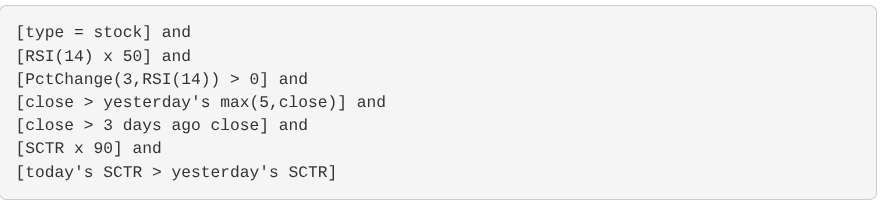
You can always start with a given code and change it to suit your criteria.
Insider Tip #2: Turn Alerts Into a Discovery Engine
Why focus on known symbols when you can set alerts for entire markets, sectors, or chartlists? What if you wanted to set an alert for all US stocks whose RSI crossing above 50 and SCTR crossing above 75?
Coding this might take some nuance and tweaking but the Chat Assistant gave me something to start with:

The main point here is that you can use alerts as idea generators rather than just reminders.
And That’s a Wrap
In addition to making your workflow more efficient and disciplined, you can see now that the tool can make it more scalable. By letting the market come to you, so to speak, you have more time to focus on either non-market stuff, or more market stuff. Experiment with it, and do the same for the Chat Assistant (as I have demonstrated). There’s only upside here.