AI Stocks Are Still in Charge. Here’s What Could Stop the Rally

Key Takeaways
- AI remains the stock market’s main driver, with strong earnings, data center spending, and semiconductor momentum keeping the bull rally alive.
- Inflation pressures are building, as rising oil, wheat, and corn prices could keep the Fed cautious and Treasury yields elevated.
- Market breadth indicators aren’t fully confirming the rally, and investors should look for signs the uptrend may be losing strength.
Oil prices are elevated, the Strait of Hormuz is still closed, peace talks with Iran haven’t made much progress, and April CPI and PPI came in hotter than expected. Yet the stock market keeps on climbing.
So far, none of it has derailed the rally. As long as companies continue to show growth in their quarterly earnings reports, and businesses keep pouring money into AI, this bull market seems to be determined to push through anything that gets in its way.
But history has taught us that markets don’t move in a straight line. In a rally this strong and this fast, investors should pay attention to what’s happening beneath the surface. When conditions start to weaken, the decline can come quickly and hit hard.
Watch Commodity Prices
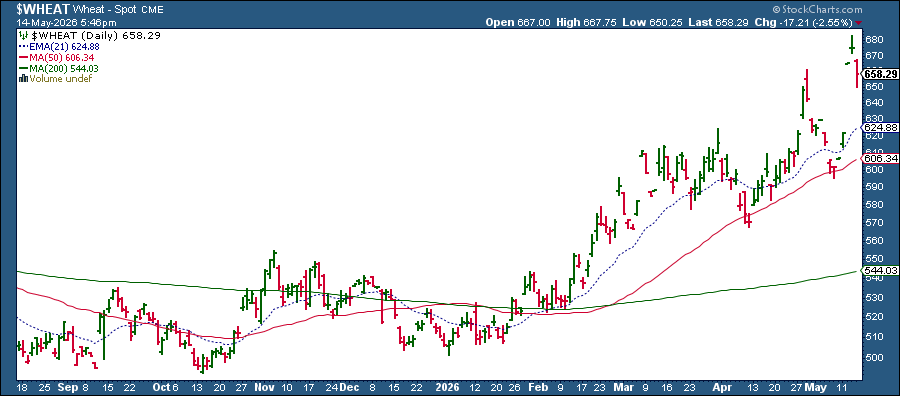
It’s not just oil prices that are moving higher. Agricultural commodities such as wheat and corn are also rising, which suggests food prices could follow a similar path in the near future. Wheat ($WHEAT) gapped up on May 12 and remains above its 21-day Exponential Moving Average (EMA).
It’s worth exploring how a rise in commodity prices could affect stocks in the food industry.
To do that, I went to the US Industries panel in the Market Summary page and clicked the Dow Industries tab. This was an idea I picked up from this article. Three food-related industries appear on the list: Food & Beverage, Food Retailers & Wholesalers, Food Products, and Restaurants & Bars.
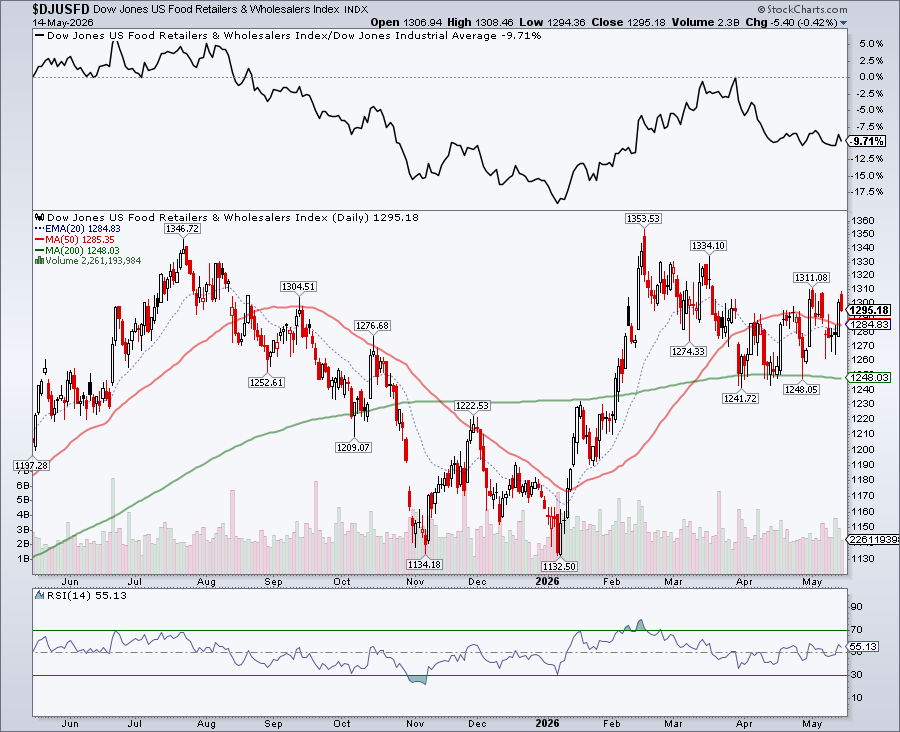
Of the three, Food Products and Restaurants & Bars are showing weak relative performance versus the S&P 500. Food Retailers & Wholesalers are holding up better, but they’re still underperforming the broader index and is rangebound (see chart below from the Market Summary ChartPack).
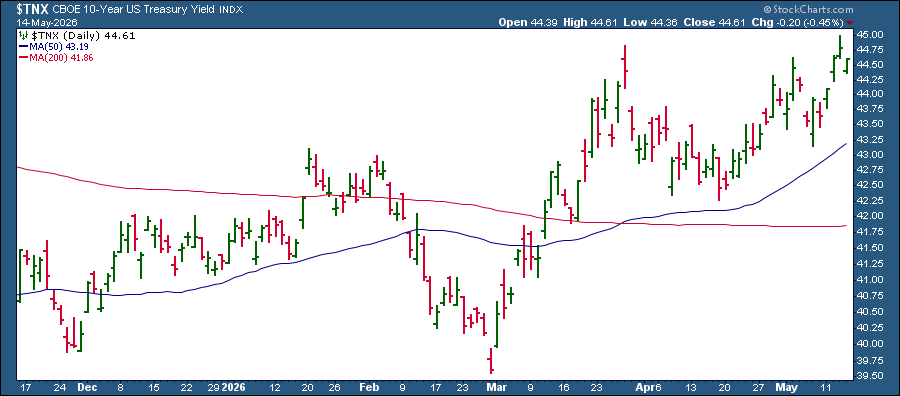
Higher inflation also makes it less likely that the Fed will cut interest rates anytime soon. According to the CME FedWatch Tool, the probability of an interest rate cut in 2026 is very low. When bond prices fall, Treasury yields rise. The 10-Year Treasury Yield closed at 4.46% on Thursday. The last time the yield was at this level was in June 2025.
In general, higher interest rates are a headwind for growth stocks. So far, though, growth stocks aren’t showing signs of slowing down, even with inflation pressures and rates likely to stay elevated. Just look at the chart of MAGS below.
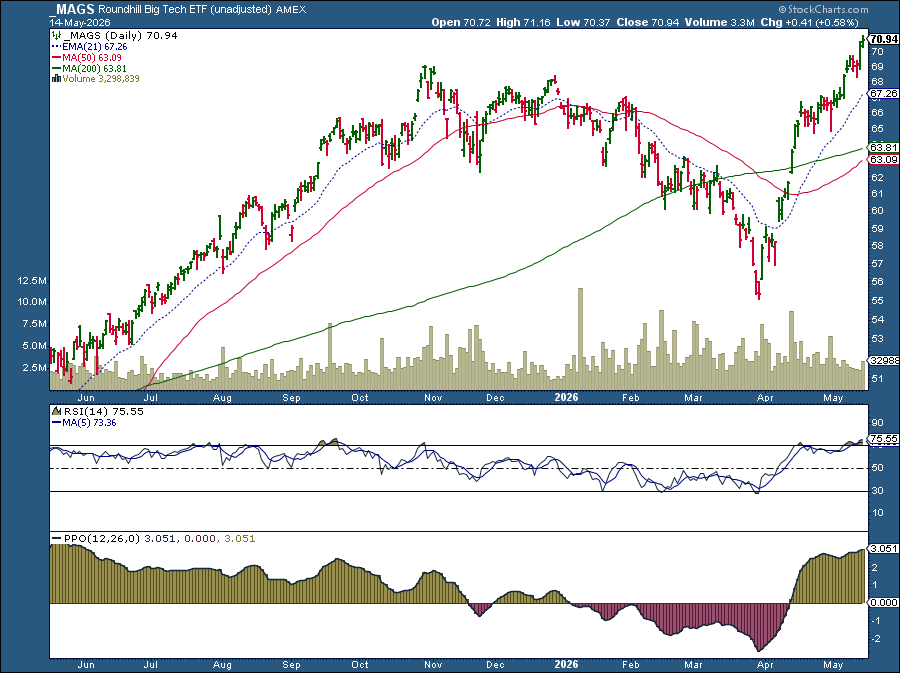
It's been rising since April without much help from Microsoft (MSFT) and Meta Platforms (META). The ETF has strong momentum behind it as seen by the Relative Strength Index (RSI) and Percentage Price Oscillator (PPO).
Cerebras (CBRS), an AI company, made its debut on Thursday. The stock opened at $350, well above its expected price. OpenAI, Anthropic, and SpaceX are waiting on the wings. Clearly, AI is still the dominant force behind this market.
But when the market gets this euphoric, investors should closely watch market internals. With the major indexes making new highs, you want to see market breadth confirm the move. Right now, that confirmation is lacking.
If you look at the Breadth panel in the Market Summary page, a few things stand out.
- New Highs-New Lows: Despite the S&P 500 and Nasdaq making new highs, the new highs-new lows data for most of the major indexes doesn’t fully support the move higher. The Nasdaq 100 has more new highs than lows compared to the other indexes, but not high enough to support the steepness of the climb. Click here to see the chart.
- Percentage of Stocks Trading Above Key Moving Averages: This is another important breadth measure. Again, the Nasdaq 100 looks stronger, with more stocks trading above key moving averages. The percentage of S&P 500 stocks trading above the 20-, 50-, and 100-day moving averages is below 50%, which doesn’t give the bullish move much confidence. Click here to see the chart.
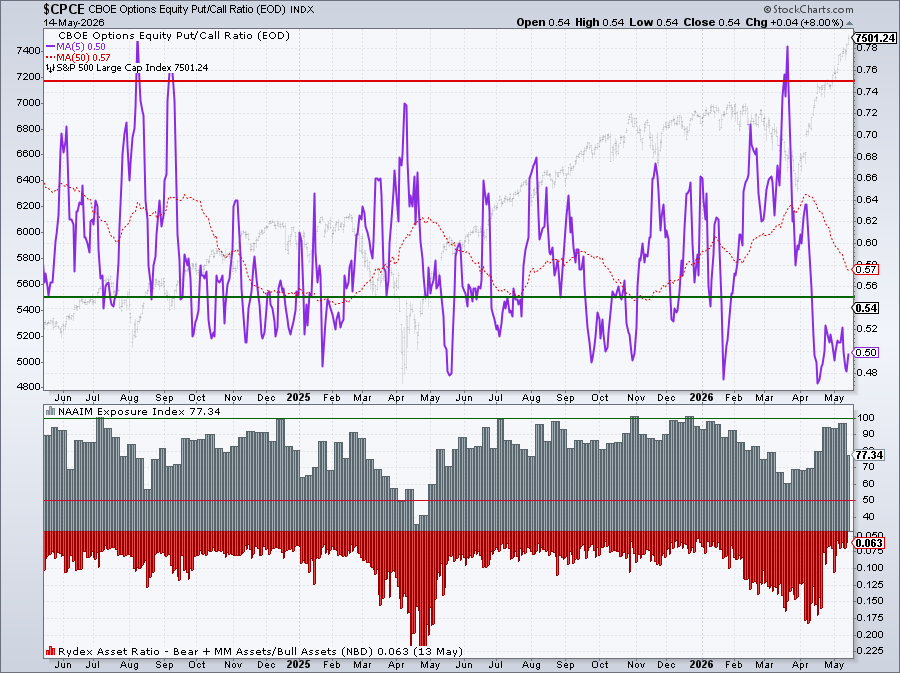
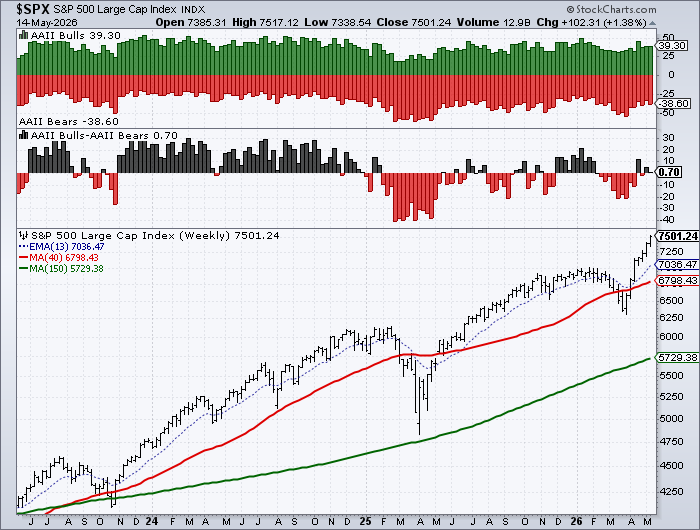
- Investor Sentiment: Two readings are worth noting. The NAAIM Exposure Index fell from around 96% to 77% on May 13, and the AAII Bulls-Bears was at 0.70. Both these readings don’t support the bullish move in equities.
It’s All About AI
AI remains front and center for most investors. Companies are increasing their AI spending and building thousands of data centers. This narrative is similar to that of 2025, when the Mag 7 stocks led the market higher.
Now, the Mag 7 stocks are back in action, but additional stocks such as SanDisk (SNDK), Micron (MU), and Intel (INTC) are helping fuel the rally, while Microsoft and Meta haven’t helped much. Next week, NVIDIA reports earnings. If the company beats estimates and delivers upbeat guidance, it could provide another tailwind for semiconductors and AI-related stocks.
What Could Slow Down the Rise in AI Stocks?
One possible bottleneck is higher US Treasury yields. If yields continue climbing, there will likely come a point when growth stocks can no longer shrug them off. When that happens, stock prices could fall, and the reality of inflation might kick in.
For now, keep your eyes on yields, food prices, and market breadth. If these three start to break down, be prepared for stocks to fall. Until then, enjoy the ride.
Disclaimer: This blog is for educational purposes only and should not be construed as financial advice. The ideas and strategies should never be used without first assessing your own personal and financial situation, or without consulting a financial professional.