Is the QQQ Building a Base or Forming a Top?

There’s no denying that we’re observing some serious leadership rotation in the equity markets. And with the Nasdaq 100 ($NDX) lagging behind the other equity indexes in Q3, investors are understandably skeptical that it will regain its leadership role and fuel a new bullish phase for stocks.
Today, I'm going to discuss four different scenarios over the next six weeks, describe the conditions that would help validate each of the four scenarios, and then assign probabilities to each potential outcome. Do you agree with the probabilities I’ve assigned? Head over to my YouTube channel and let me know!
First, let’s dig a little more into the leadership rotation phenomenon and show how the trend in the Nasdaq 100 has rotated to a consolidation phase. A quick review of the Nasdaq 100 vs. other major equity indexes shows how all three were in similar trends through the end of May. From the beginning of June, however, the Invesco QQQ Trust (QQQ) has forged a different path from the S&P 500 ($SPX).
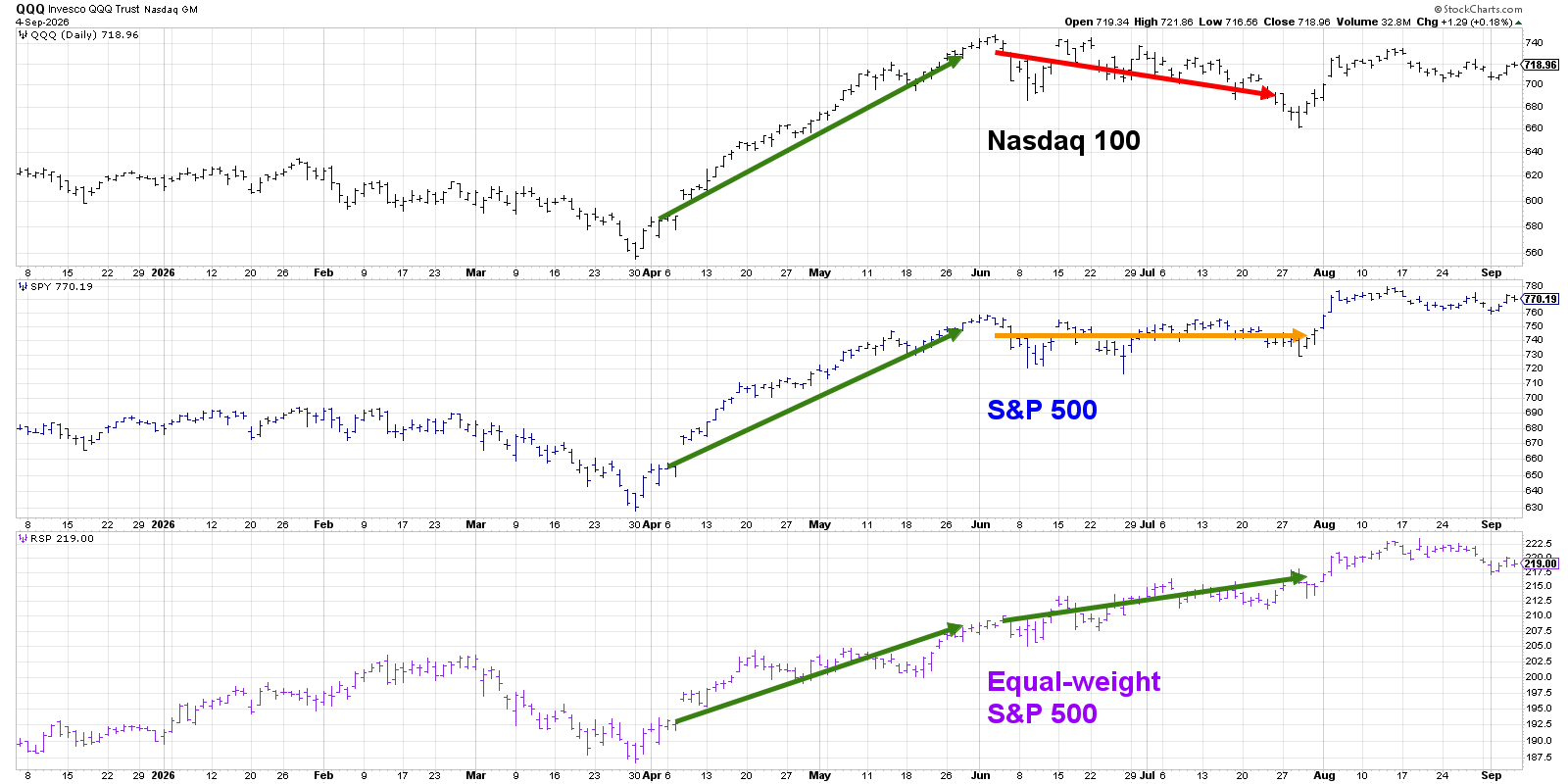
The Nasdaq 100 last made a new all-time high during the first week of June. From that point on, the QQQ has been unable to revisit this previous market peak. The S&P 500 made a new high in early August, but that was after two months of sideways price action. The equal-weighted S&P 500 remains the only major index that has achieved a new all-time high every month since the end of May.
Why is the underperformance of the Nasdaq 100 such an issue for the equity markets? Quite simply, the equity benchmarks are heavily weighted to the growth sectors, especially Technology. So, if mega-cap growth stocks are lagging, then it’s hard to imagine the S&P 500 mounting any meaningful upside trend.
So it all comes down to the QQQ and what comes next. With that in mind, let’s review the four scenarios for the Nasdaq 100 ETF between now and mid-October 2026. If this is your first time with this exercise in “probabilistic analysis”, here’s what we’re trying to do together:
- Consider all four potential future paths for the ETF, think about what would cause each scenario to unfold in terms of the macro drivers, and reflect on what signals/patterns/indicators would confirm the scenario.
- Decide which scenario you feel is most likely, and why you think that's the case. (Don't forget to drop me a comment and let me know your vote!)
- Think about how each of the four scenarios would impact your current portfolio. How would you manage risk in each case? How and when would you take action to adapt to this new reality?
Here’s the chart we’ve created to illustrate the four scenarios. You’ll find a breakdown of each scenario below, along with the probability I’ve assigned for each scenario. Disagree with me? Jump over to my YouTube channel and drop a comment. Tell me why I’m wrong!
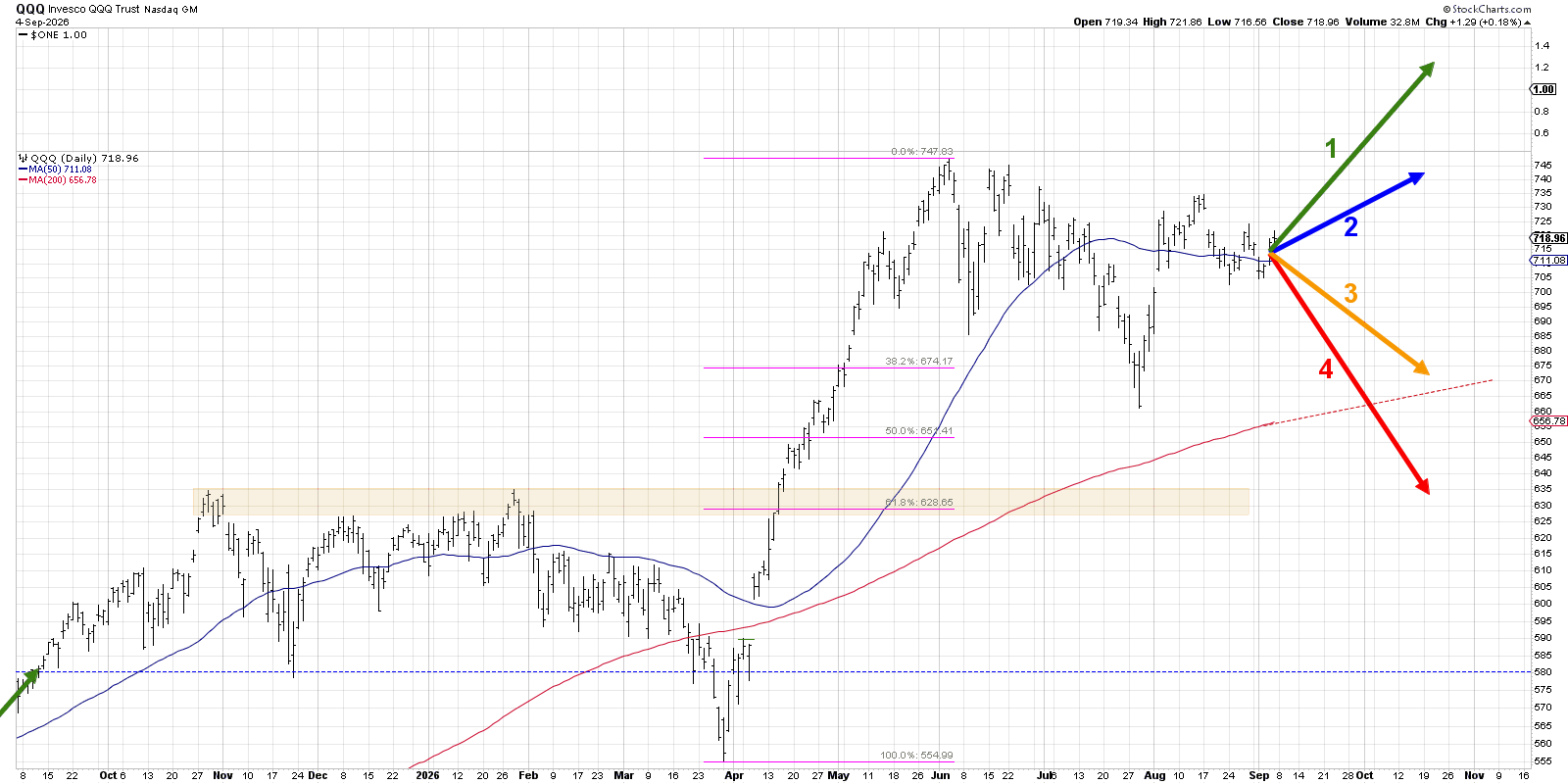
Let’s start with a super bullish outcome, where the Nasdaq resumes its previous leadership role, achieving new all-time highs into Q4.
Scenario 1: The Super Bullish Scenario
The Nasdaq 100 resumes its primary uptrend, breaks above the June all-time high, and pushes to new highs, potentially reaching the 770–780 area. For this scenario to play out, Technology would need to reclaim market leadership, with semiconductors in particular returning to a strong uptrend. Renewed optimism around AI could provide the catalyst, with mega-cap growth stocks once again driving the major averages higher.
Given the seasonal tendencies for September, which is usually one of the worst months for stocks during a midterm election year, I see this as a possible but highly unlikely scenario.
Dave’s Vote: 5%
Scenario 2: The Mildly Bullish Scenario
The Nasdaq 100 remains within its recent trading range but gravitates toward the upper end, potentially retesting the June highs around 740–745 without actually breaking out. Semiconductors wouldn't necessarily need to become major leaders again, but they would need to stabilize and avoid further breakdowns. Communication Services and Consumer Discretionary could also improve, allowing the QQQ to drift higher even as leadership remains broader and more balanced than it was earlier in the year.
The only reason why I’m seeing this as a real possibility is because we’ve seen echoes of AI euphoria bubbling back up in the markets. Charts like NVIDIA (NVDA) suggest that there is still plenty of upside potential for the AI trade, and it feels like it wouldn’t take much for the FOMO to bubble over yet again.
Dave’s vote: 20%
Scenario 3: The Mildly Bearish Scenario
The Nasdaq 100 rotates lower and retests the July lows, the 200-day moving average, and the 38.2% Fibonacci retracement around $675. Higher interest rates could continue to pressure growth stocks, allowing value-oriented areas such as Health Care, Financials, Industrials, or even small caps to outperform. The key distinction is that support ultimately holds, leaving the Nasdaq rangebound and potentially setting up a significant low heading into the historically stronger fourth quarter.
Given the lack of momentum in the chart of the Nasdaq, along with the seasonal weakness mentioned above, this feels like the most likely scenario for me!
Dave’s vote: 60%
Scenario 4: The Super Bearish Scenario
A full risk-off move develops as the Nasdaq 100 breaks below the July lows, the 675 support area, and ultimately the 200-day moving average. A combination of renewed geopolitical concerns, persistent inflation, or more hawkish Fed expectations could contribute to the decline, with the QQQ potentially falling toward 630–640 and a 61.8% retracement of the April–May rally. Defensive sectors such as Consumer Staples, Real Estate, and Utilities would likely improve as investors seek safety, providing an important confirmation that the most bearish scenario is playing out.
It’s worth noting that after doing many of these “choose your own adventure” style videos, the super bearish scenario rarely actually plays out. But it only takes one occurrence to destroy your portfolio, which is why I always spend plenty of time working through the doomsday scenario!
Dave’s vote: 15%
Which Scenario Gets Your Vote?
If I had to summarize the four paths:
- Scenario 1 assumes a return to a leadership role for the QQQ, as it pops to new all-time highs and beyond.
- Scenario 2 envisions a retest of the 2026 highs, but just not enough upside momentum to push higher.
- Scenario 3 suggests a retest of the Q2 lows, as value sectors generally outperform their growth counterparts.
- Scenario 4 assumes a major downturn for growth stocks, as investors go full risk-off going into Q4.
By considering multiple outcomes before they occur, we're far less likely to be surprised by market behavior. More importantly, we can identify the signals that would increase or decrease the probability of each scenario and adjust our positioning accordingly.
So which scenario do you find most compelling?
RR#6,
Dave
P.S. Ready to upgrade your investment process? Check out my free behavioral investing course!
David Keller, CMT
President and Chief Strategist
Sierra Alpha Research LLC
marketmisbehavior.com
https://www.youtube.com/c/MarketMisbehavior
Disclaimer: This blog is for educational purposes only and should not be construed as financial advice. The ideas and strategies should never be used without first assessing your own personal and financial situation, or without consulting a financial professional.
The author does not have a position in mentioned securities at the time of publication. Any opinions expressed herein are solely those of the author and do not in any way represent the views or opinions of any other person or entity.