Choose Your Own Adventure: Mapping the S&P 500’s Next Move

The S&P 500 index has stalled out after achieving a dramatic move above 7000. While that milestone was enough to compel me to play a fanfare on my daily market recap show, the follow through after that breakout has been less than optimal.
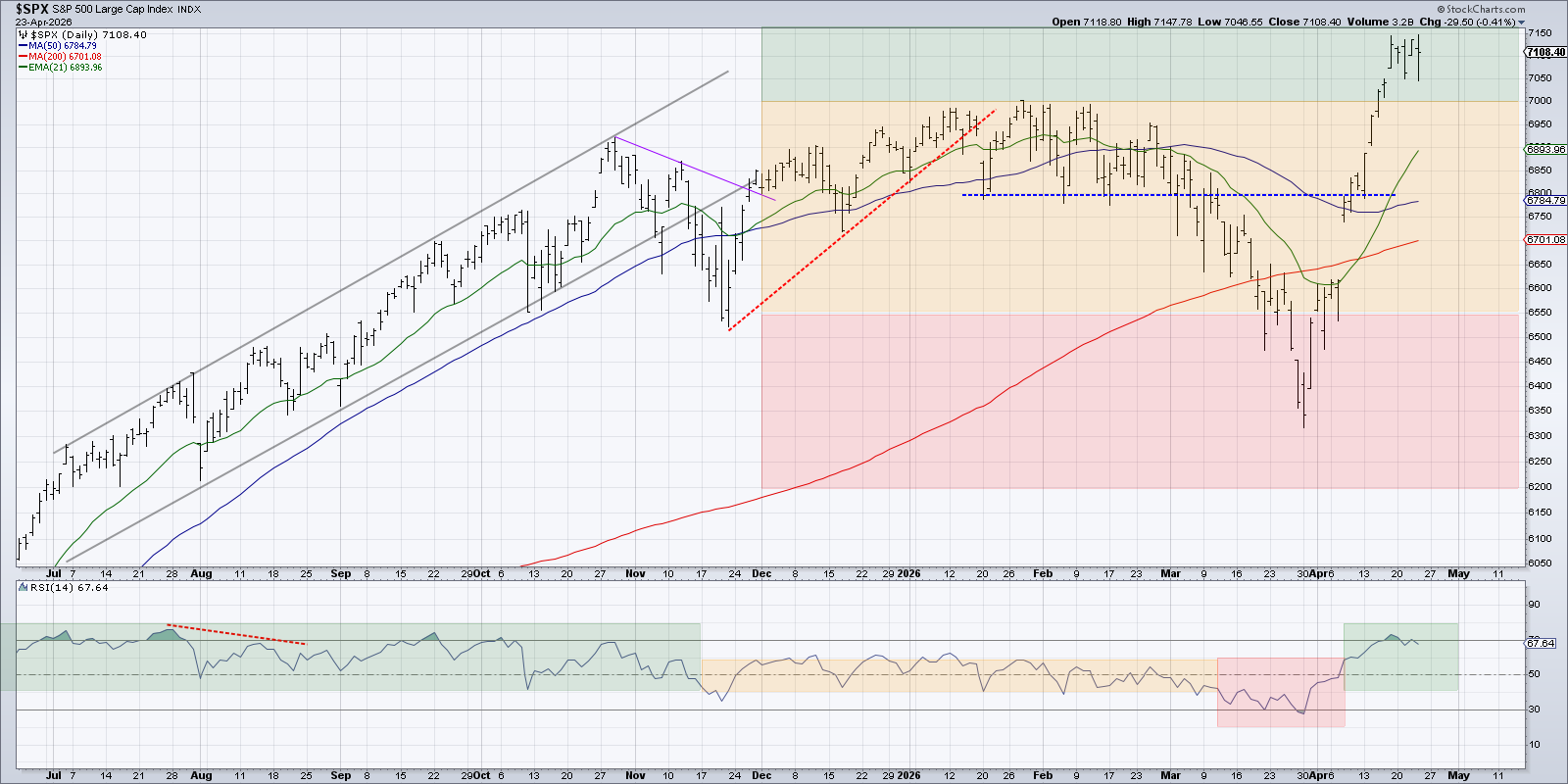
Since last Friday’s gap higher to achieve a first close above 7100, the S&P 500 index has stalled out. The index has spent the entire week since that breakout hovering in the same range! Thus, with the lack of upside confirmation for the major indexes, investors are left to speculate about what may come next.
Today, I'm going to revisit one of my favorite exercises, a probabilistic analysis or “choose your own adventure” approach to considering alternative scenarios. Basically, I’ll reveal four potential future paths for the S&P 500 over the next six to eight weeks. By selecting one of the scenarios as the most probable, you’ll cast your vote and clearly articulate your investment thesis. Then, by listening to the four different scenarios and considering all the possibilities and merits of each outcome, you’ll be able to open your mind to alternative points of view.
Before we get to the current chart and four outcomes for the S&P 500 index, let’s revisit our previous exercise from February 2026. We ended up posting this video just before the market rolled over into March, so if you voted on one of the bearish scenarios, congratulations, you were spot on!
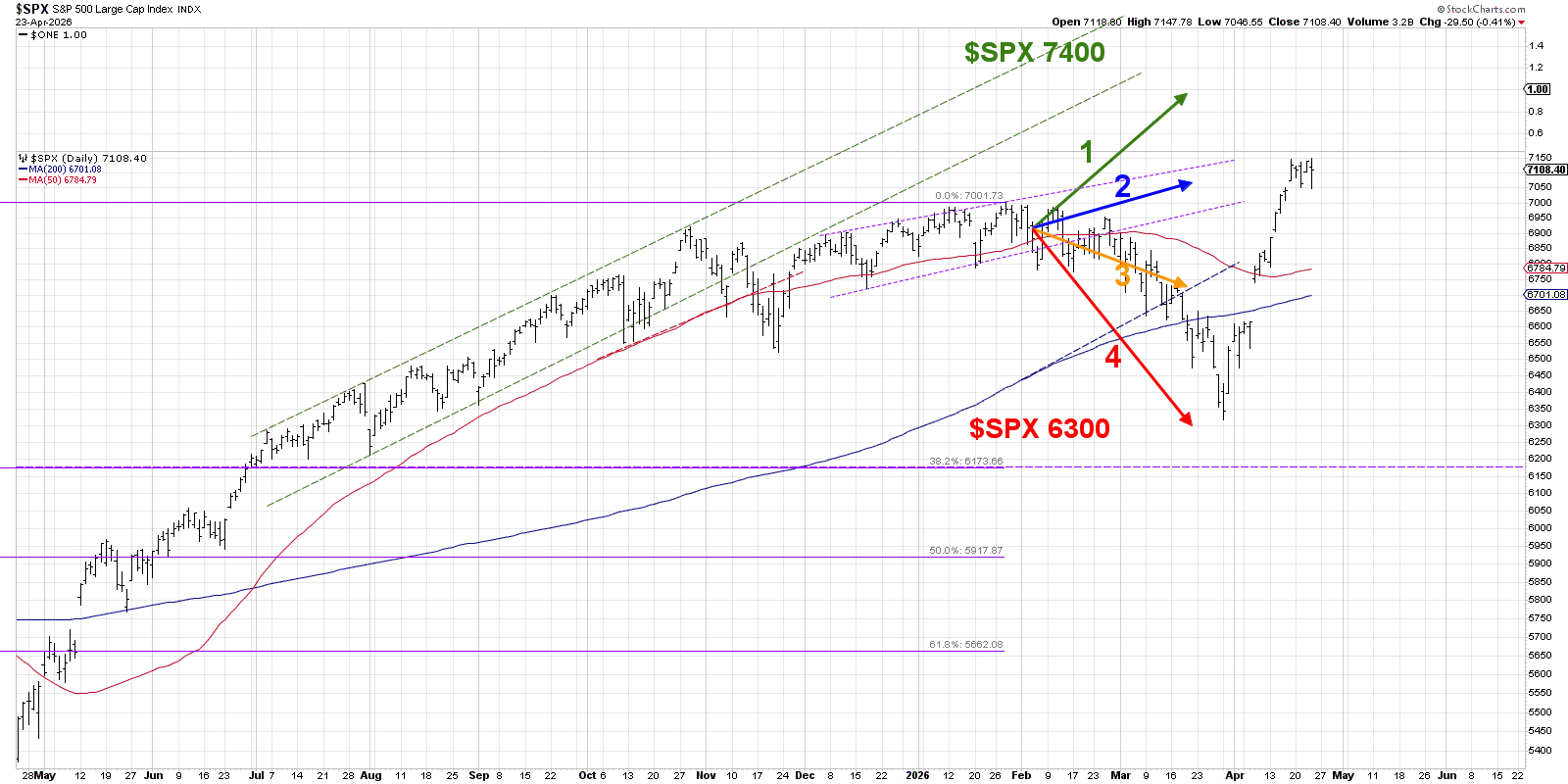
Our two bearish scenarios involved an escalation of the conflict in the Middle East, a rotation to defensive sectors, and big warning signs from risk indicators such as credit spreads and volatility. Sure enough, pretty much all of those danger signals flashed in March, as the S&P 500 went into a full risk-off mode into the late March low.
Back to the current markets, let’s review the four scenarios for the S&P 500 index between now and mid-June 2026. As a friendly reminder, the point of this exercise is threefold:
- Consider all four potential future paths for the index, think about what would cause each scenario to unfold in terms of the macro drivers, and reflect on what signals/patterns/indicators would confirm the scenario.
- Decide which scenario you feel is most likely, and why you think that's the case.
- Think about how each of the four scenarios would impact your current portfolio. How would you manage risk in each case? How and when would you take action to adapt to this new reality?
Here’s the chart we’ve created to illustrate the four scenarios. You’ll find a breakdown of each scenario below, along with the probability I’ve assigned for each scenario. Disagree with me? Jump over to my YouTube channel and drop a comment. Tell me why I’m wrong!
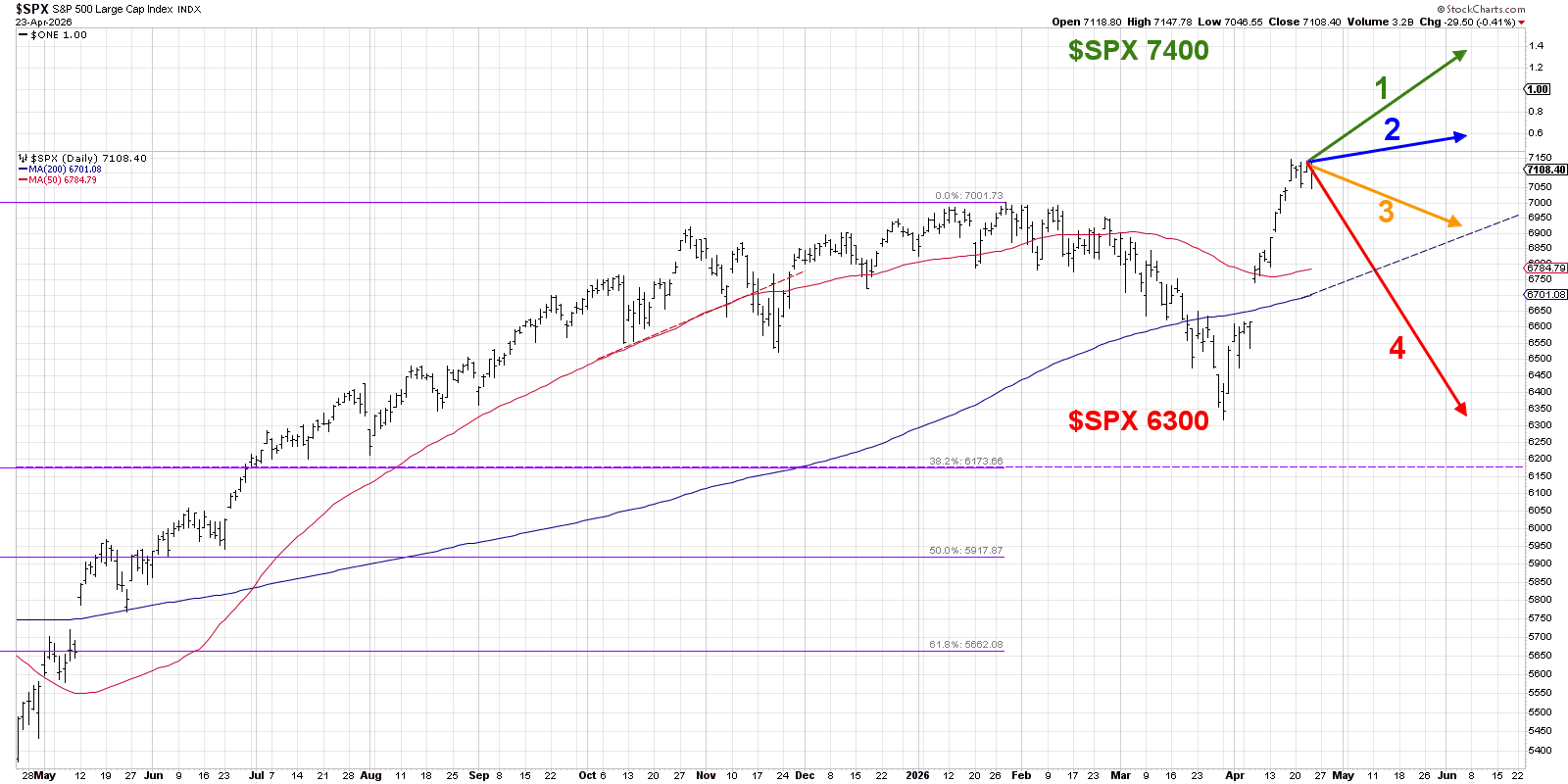
Let’s start with a super bullish outcome, where the S&P 500 index continues onward and ever upward through Q1!
Scenario 1: The Super Bullish Scenario
Consider me firmly in the camp of “I can’t imagine the uptrend from the last couple of weeks just keeps going higher without any meaningful pullback.” But it's a possibility, and Scenario 1 is meant to illustrate that. If the recent strength in the Magnificent 7 stocks continues, and other sectors like Industrials and Materials resume their uptrends, it’s reasonable to expect the S&P 500 to reach 7400 by mid-June.
The Cboe Volatility Index (VIX) would need to remain mostly below 20, signaling low uncertainty and relative stability. From a macro perspective, the situation in the Middle East would come to an abrupt end, which would allow investors to focus on earnings optimism and how well the economy will shrug off all the negativity.
Dave’s Vote: 5%
Scenario 2: The Mildly Bullish Scenario
What if the U.S. remains firmly engaged in the Middle East, with no clear end in sight but also no real escalation in hostilities? Perhaps the Strait of Hormuz is opened with restrictions, and that’s enough to ease investors’ concerns about long-term economic impact.
The mildly bullish scenario would mean a lighter version of the market rally from the end of March, as sectors like Technology continue to shine, but there’s no broad participation from other sectors. Perhaps we remain in this quagmire of “will this affect earnings?” thinking, and as a result, the S&P 500 just sort of drifts higher with no real catalyst but no real threats as well.
Dave’s vote: 35%
Scenario 3: The Mildly Bearish Scenario
The bearish scenarios are most likely driven by some combination of three key macro factors: the conflict in the Middle East re-escalates to the point that investors are preparing for more long-term impacts, earnings estimates start to reflect lower expectations for future earnings growth, or economic data begins to imply that conditions are way worse than expected.
From a technical perspective, I would expect limited stocks and groups to continue to press new highs as a pullback commences for the major equity averages. Defensive sectors would likely start to improve, as investors flock to low-volatility positions as the VIX spikes above 20. By mid-June, we’re debating whether the 200-day moving average will hold this time.
Dave’s vote: 45%
Scenario 4: The Super Bearish Scenario
Every exercise needs a doomsday scenario, where everything just seems to go wrong. In Scenario 4, events in the Middle East take a decidedly downward turn, as tensions boil over among various global powers. The Strait of Hormuz remains closed, and economies start to feel the long-term effects of the disruption to the global energy supply.
In my view, a super bearish scenario here means a retest of the March swing low around SPX 6300. All the classic risk-off signals would fire, from widening credit spreads and a spike in the VIX, to a rally in defensive sectors and a spike in interest rates. The U.S. dollar becomes the best chart around, as safe-haven trades rule the day.
Dave’s vote: 15%
What probabilities would you assign to each of these four scenarios? Check out the video below, and then drop a comment with which scenario you select and why. And don’t forget to review the votes and comments from your fellow investors!
RR#6,
Dave
P.S. Ready to upgrade your investment process? Check out my free behavioral investing course!
David Keller, CMT
President and Chief Strategist
Sierra Alpha Research LLC
marketmisbehavior.com
https://www.youtube.com/c/MarketMisbehavior
Disclaimer: This blog is for educational purposes only and should not be construed as financial advice. The ideas and strategies should never be used without first assessing your own personal and financial situation, or without consulting a financial professional.
The author does not have a position in mentioned securities at the time of publication. Any opinions expressed herein are solely those of the author and do not in any way represent the views or opinions of any other person or entity.