The Danger of Falling in Love With Market Leaders

One of the most important lessons I’ve learned throughout my career is that successful investing isn't simply about finding the next big winner. It's also about protecting your capital and recognizing when the evidence has changed enough that it's time to step aside.
That lesson is particularly relevant today, as investors have understandably gravitated toward dominant mega-cap technology and premium software companies leading the artificial intelligence revolution. Many of these companies have pristine balance sheets, massive cash generation, and powerful competitive advantages. From an operational standpoint, they may be exceptional businesses.
But a great company isn't necessarily a great investment at any price.
Market history reminds us that trees don't grow to the sky. When expectations become extreme, even a modest change in growth or economic conditions can trigger significant valuation compression.
The Nifty Fifty Lesson
For a historical blueprint, look beyond the speculative companies of the late-1990s dot-com bubble and back to the early 1970s.
During that era, investors fell in love with an elite group of roughly 50 high-quality companies known as the “Nifty Fifty”. Companies such as Coca-Cola (KO), Disney (DIS), and Xerox (XRX) were viewed as exceptional franchises with strong growth prospects, businesses investors believed could be bought and held regardless of price.
When the Nifty Fifty eventually declined, it wasn't necessarily because these companies stopped being great businesses. Valuations had simply become too high relative to what investors were willing to pay for their growth. And that distinction matters today.
A stock can decline sharply even while its underlying business remains fundamentally strong. When expectations are priced for perfection, the market has little room for disappointment.
Watch For the Technical Footprints
When institutional investors begin reducing positions in crowded growth stocks, the selling can leave technical clues.
High-volume down days: These are days where a stock or index closes lower on significantly heavier-than-normal volume, suggesting increased institutional selling pressure. One day isn't necessarily meaningful, but a pattern of distribution is.
Selling on good news: This is when a company reports strong earnings and the stock gaps higher, only to then reverse lower on heavy volume. When positive news fails to attract sustained buying, expectations may already be too high.
Weakening market breadth: This is when major indexes remain near their highs while fewer individual stocks participate in the advance. This can signal that capital is becoming increasingly concentrated in a small group of market leaders. We are seeing that happen right now.
These signals don't predict a top, but they tell us to pay closer attention to what the market is doing.
Protecting Capital
For premium growth leaders, I pay particular attention to the 50-day moving average.
A break below it on heavy volume doesn't automatically mean a stock should be sold. But when a leading stock breaks this key support level and fails to quickly reclaim it, and when other signs of institutional distribution are appearing alongside this development, the evidence may have changed enough to warrant reducing exposure.
The goal isn't to predict the exact top, but instead to recognize when the risk/reward equation has changed. Great companies can remain great companies. Successful investing requires knowing when the market is no longer rewarding them at the same price.
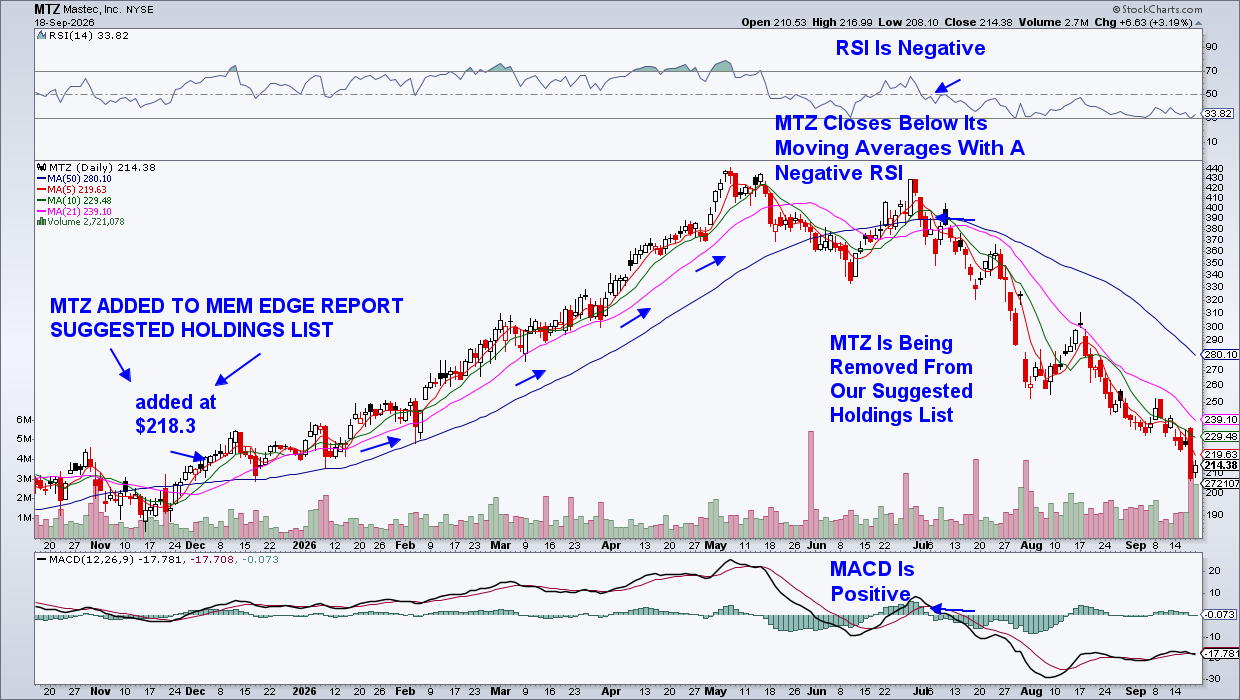
Mastech, Inc. (MTZ) was one such company. After its bull run from November 2025 to May 2026, the technical signals started flashing signs of a selloff. When MTZ closed below its moving averages with a negative Relative Strength Index (RSI), we removed the stock from our suggested holdings list.
Use this link here to stay on top of the current market conditions and be alerted when today’s leaders are beginning to reverse. You’ll be directed to access my twice-weekly MEM Edge Report at no cost for two weeks.
Warmly,
Mary Ellen McGonagle
MEM Investment Research