Will the Hawkish Fed Cause a Major Market Top?
Consider the question in the title. It's easy to think that this is the case, but I'd be very careful about making that assumption.
While the Fed did just announce a unanimous decision to raise the fed funds target range by a quarter point, history tends to side with the bulls when the Fed begins a rate-hiking campaign. In the near-term, however, we might have to deal with a bit of weakness as we navigate September and October. Let's take a trip down memory lane and see what happened earlier this century when the Fed embarked on a series of rate hikes.
June 30, 2004–June 29, 2006
The Fed raised the fed funds rate a total of 17 times during these two years. The rate jumped from 1.00% at the beginning of the period to 5.25% at the end of the period. Here's how the S&P 500 ($SPX) performed leading up to the start of this rate-hiking cycle to just after the end of it.
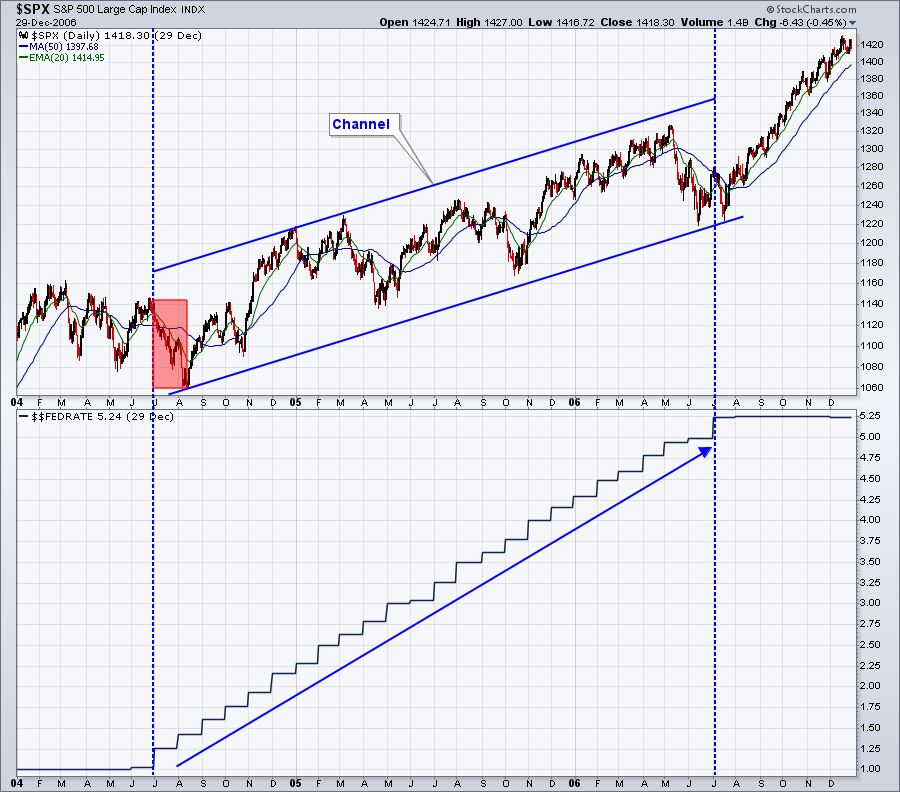
Over the first several weeks, the S&P 500 struggled, dropping 7–8% right after that first rate hike. But the next 16 rate hikes occurred during a very clear S&P 500 uptrend.
December 16, 2015–December 19, 2018
The Fed was at it again, this time raising the fed funds rate nine times over three years. The rate jumped from a range of 0.00%–0.25% to a range of 2.25%–2.50% during this 3-year rate-hiking cycle. Here's how the S&P 500 handled it.
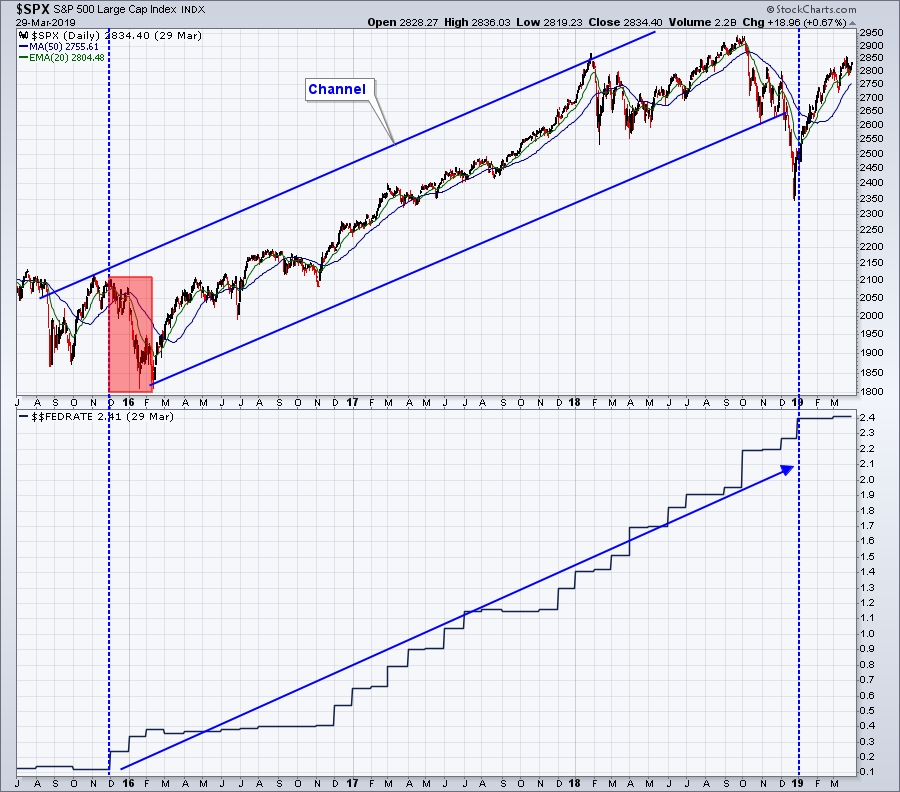
Once again, the S&P 500 took an immediate hit over the first several weeks, dropping from a high of roughly 2100 in early December 2015 to an intraday low of 1812 about six weeks later. After the initial decline, though, the S&P 500 was off to the races, gaining significant ground while the Fed kept hiking rates.
March 16, 2022–July 26, 2023
During this rate-hiking campaign, the fed funds rate surged from a range of 0.00%-0.25% to a range of 5.25%-5.50% in just over one year. That series of significant rate hikes surely caused stock market problems, right?
Well, here's the chart.
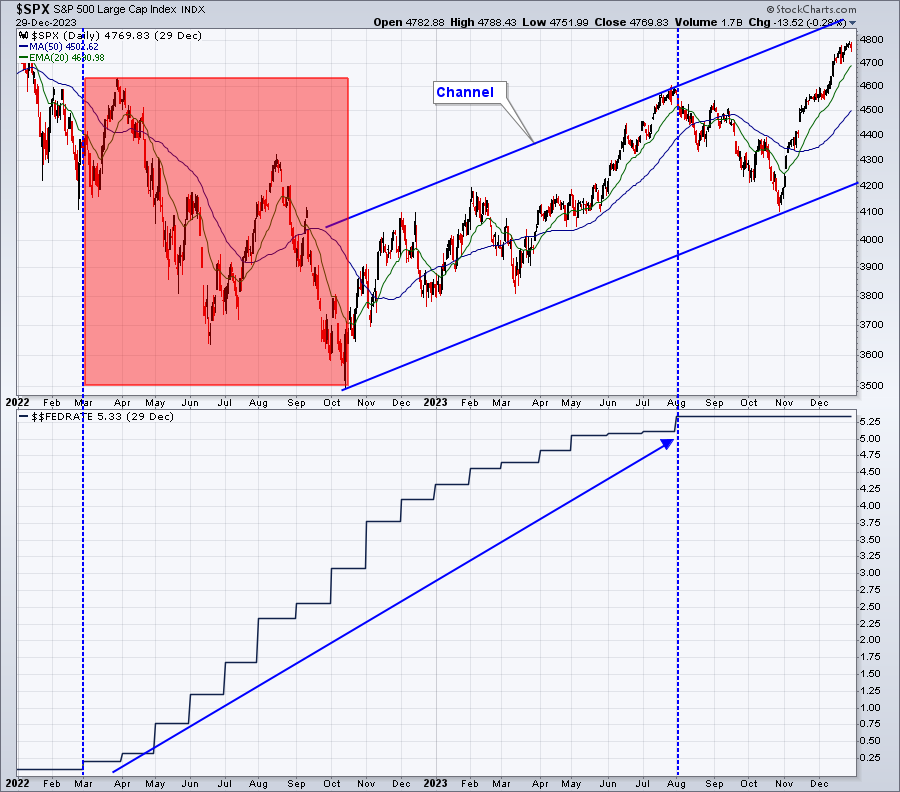
The first rate hike in March 2022 occurred as inflation was gaining steam and the S&P 500 was already in the midst of a cyclical bear market. What's interesting, however, is that, after several months of weak market action, the S&P 500 reversed and began channeling higher while the Fed kept raising rates.
Longer Rate Hike Cycle History
I read a recent Yahoo Finance article that featured an analysis from strategists at The Kobeissi Letter. It was a study of rate hikes and their impact on the S&P 500 over a longer 38-year period since 1988. They concluded that the S&P 500 gets hit by an average of roughly 4% over the initial 6-week period following the first rate hike, but then recovers those losses.
The three cases that we looked at this century seem to confirm the study's results, though I didn't research all the way back to 1988.
Can the Stock Market Be Timed?
Well, if you're expecting the start of a rate hike cycle to provide you the perfect timing for a long-term stock market top, I'd say absolutely not. But I've done a ton of research on market tops, and the Fed's actions have little to do with major market tops. But there is one signal that I've found that has called every major market top this century, except for the pandemic, and I'm going to discuss it in two weeks.
FREE LiveStream Event
On Saturday, October 3rd, at 10 am ET, I'm planning to spend an hour or so showing you my proprietary signal that has triggered at or just before every single major market top this century, other than the pandemic. If you'd like to tune in and learn more, simply CLICK HERE to register with your name and email address to save your seat! I hope to see you there!
Happy trading!
Tom