The VIX Spiked 70%: Is a Market Rebound Around the Corner?

If Thursday's market selloff caught your attention, you weren't alone. The Cboe Volatility Index (VIX) surged as much as 70% intraday, reaching 28.09, its highest level in seven months. That's quite a move, and it tells us something important about investor psychology.
Often referred to as Wall Street's "fear gauge," the VIX measures expected market volatility over the next 30 days based on S&P 500 ($SPX) options pricing. At Thursday's peak, options markets were pricing in potential daily S&P 500 moves of approximately 1.75%.
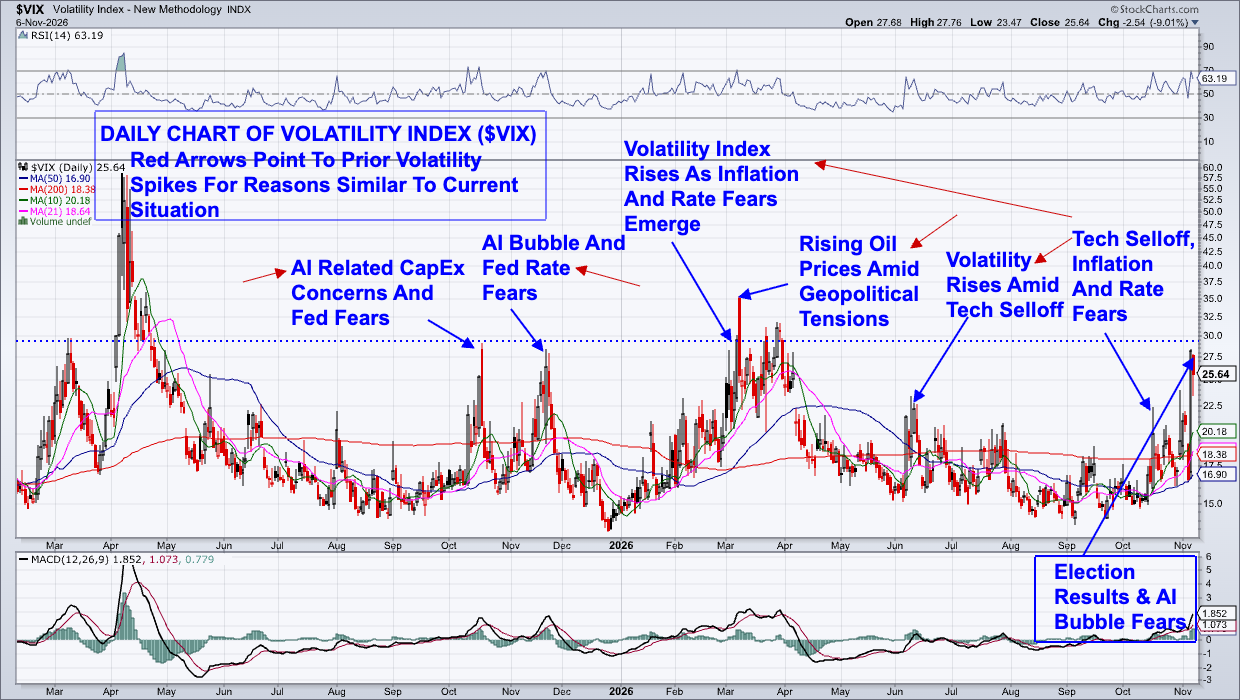
A sharp spike in the VIX can reflect more than investor anxiety, however. It can also contribute to additional selling.
When volatility jumps, institutional investors and systematic trading strategies often reduce stock exposure. Risk models, margin requirements, and automated trading programs can trigger additional selling, while demand for downside protection drives options premiums higher and reduces market liquidity. The result can become a vicious cycle: Selling creates more volatility, which triggers additional selling. Stocks also tend to move more closely together, meaning even fundamentally sound companies can get caught up in the selling.
The good news is that these episodes don't last forever, and history offers some useful clues about what may happen next.
What Happens After an Extreme VIX Spike?
A sharp rise in volatility can mark an important market inflection point, but it doesn't necessarily mean the bottom is in.
Initial rebounds often develop as short sellers cover positions and oversold stocks attract buyers. However, institutional selling can take time to work through the system, leaving the market vulnerable to additional pullbacks and retests.
History suggests a general pattern:
The August 2024 volatility shock, triggered in part by the unwinding of the yen carry trade, provides a good example. Although the market experienced an aggressive intraday reversal, it took several trading sessions to stabilize before recovering its losses.
The takeaway is that you should not confuse the first bounce with an all-clear signal.
Day One of the Rebound Is Behind Us. Now What?
So far, we've covered the first day of the potential 1–3 day rebound window following Thursday's volatility spike. Initial advances are often driven by short covering, bargain hunting, and the unwinding of defensive positions rather than a sudden improvement in the economic or earnings outlook. But the next couple of sessions should tell us more.
Two developments would help confirm that selling pressure is subsiding. One is Volatility Normalization, meaning a sustained decline in the VIX along with a return to a more normal futures structure; this would suggest that demand for immediate downside protection is easing. The other is Selling Exhaustion, meaning a high-volume washout followed by stronger closing prices and improving market breadth; this would indicate that institutional selling is being absorbed.
Not All Stocks Are Being Treated Equally
One of the more interesting aspects of this decline is the damage inflicted on individual stocks. AI infrastructure names, particularly semiconductor, memory, and data center-related companies, have experienced significantly steeper declines than many other areas of the market. AI leaders that have broken below their 50-day moving averages on heavy volume may need considerable time to repair their charts, while fundamentally sound companies in less crowded areas of the market are already attracting institutional buying.
I added two fundamentally sound stocks to my MEM Edge Report Suggested Holdings List after last week’s election-related rout, and will be adding more in Sunday’s report. This was after removing Semiconductor stocks throughout October.
If you’d like a no-cost 2-week trial of my twice-weekly MEM Edge Report, use this line here. In addition to stock ideas, you’ll be kept up to date with the rotation taking place in the markets, with an emphasis on those stocks poised to trade higher for longer. Key support levels for the markets are also reviewed.
The Bottom Line
Extreme volatility can be unsettling, but it can also create attractive opportunities for investors who are prepared. Thursday's dramatic VIX spike has already produced the first day of a potential short-term rebound. And the stocks that are setting up to outperform are already providing signals.