Bearish Divergence or Bullish Trend? Here's What Matters

We’ve been tracking the renewed dominance of the Technology sector on our daily market recap show. In particular, we've noted how a small number of software names have been showing strength on par with the best semiconductor stocks.
CrowdStrike (CRWD) in particular stands out because even though the price has been trending higher through Q3, the momentum has been trending lower. This bearish momentum divergence has appeared multiple times as the software name has achieved further highs in September.
So how many divergences are too many?
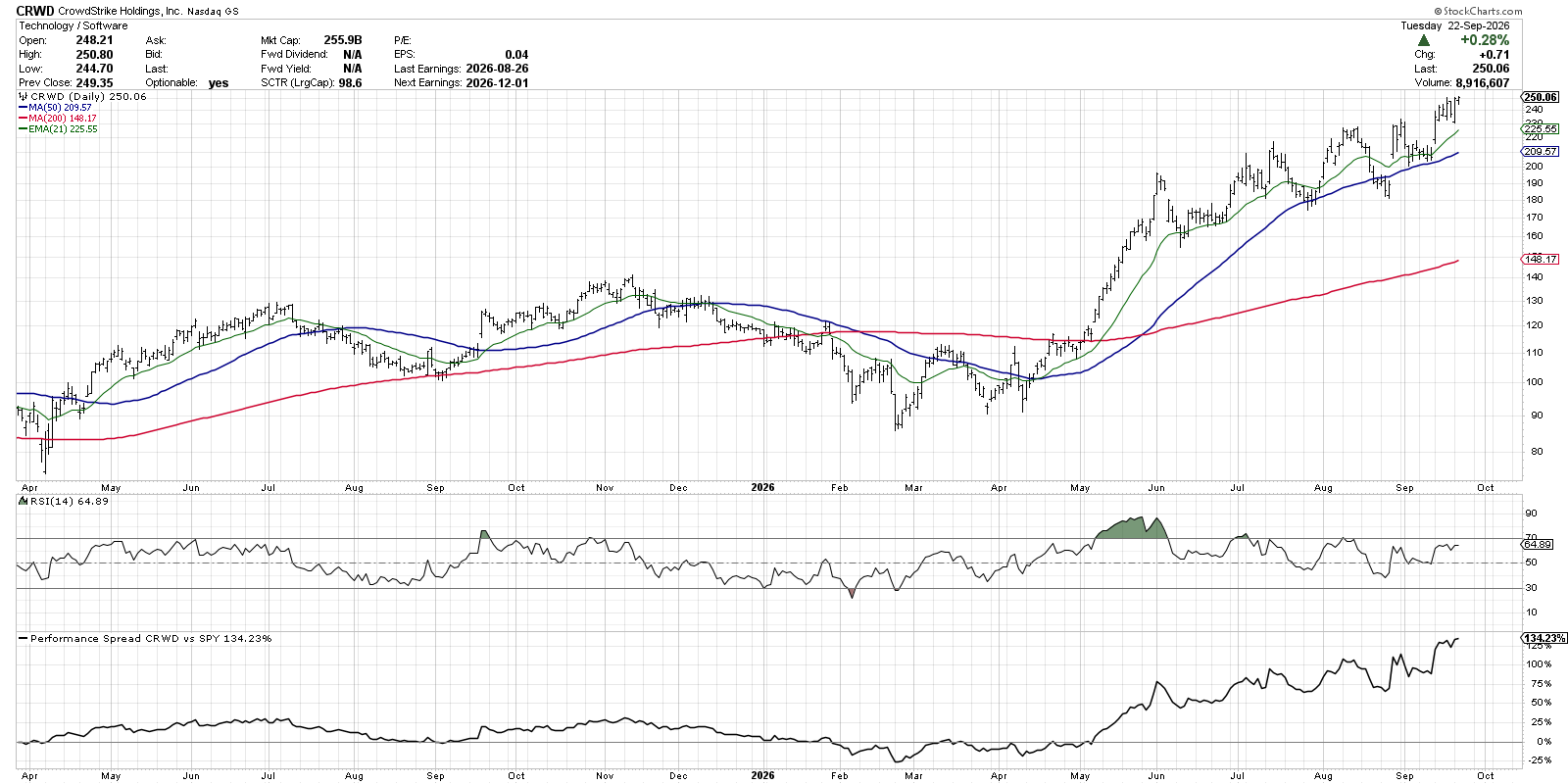
First, we need to define the uptrend. The price currently sits above three upward-sloping moving averages. What’s most notable in price is the uniformity of the pullbacks. Note how each pullback has found support at least slightly above the previous swing low, suggesting that dip buyers are coming in to propel the stock to a new swing high.
Second, let’s check out the momentum picture. While the Relative Strength Index (RSI) has been sloping downwards, we also need to note that it has remained above 40, and often above 50, on those pullbacks. This validates the primary uptrend in place, and also echoes earlier comments on dip buyers coming in on short-term price weakness.
Finally, the relative strength (lowest panel) has been trending “onward and ever upward”, signifying that the stock has been outperforming the S&P 500 ($SPX). This last indicator is a natural extension of the bullish trend and momentum characteristics, as strong charts tend to outperform the benchmark.
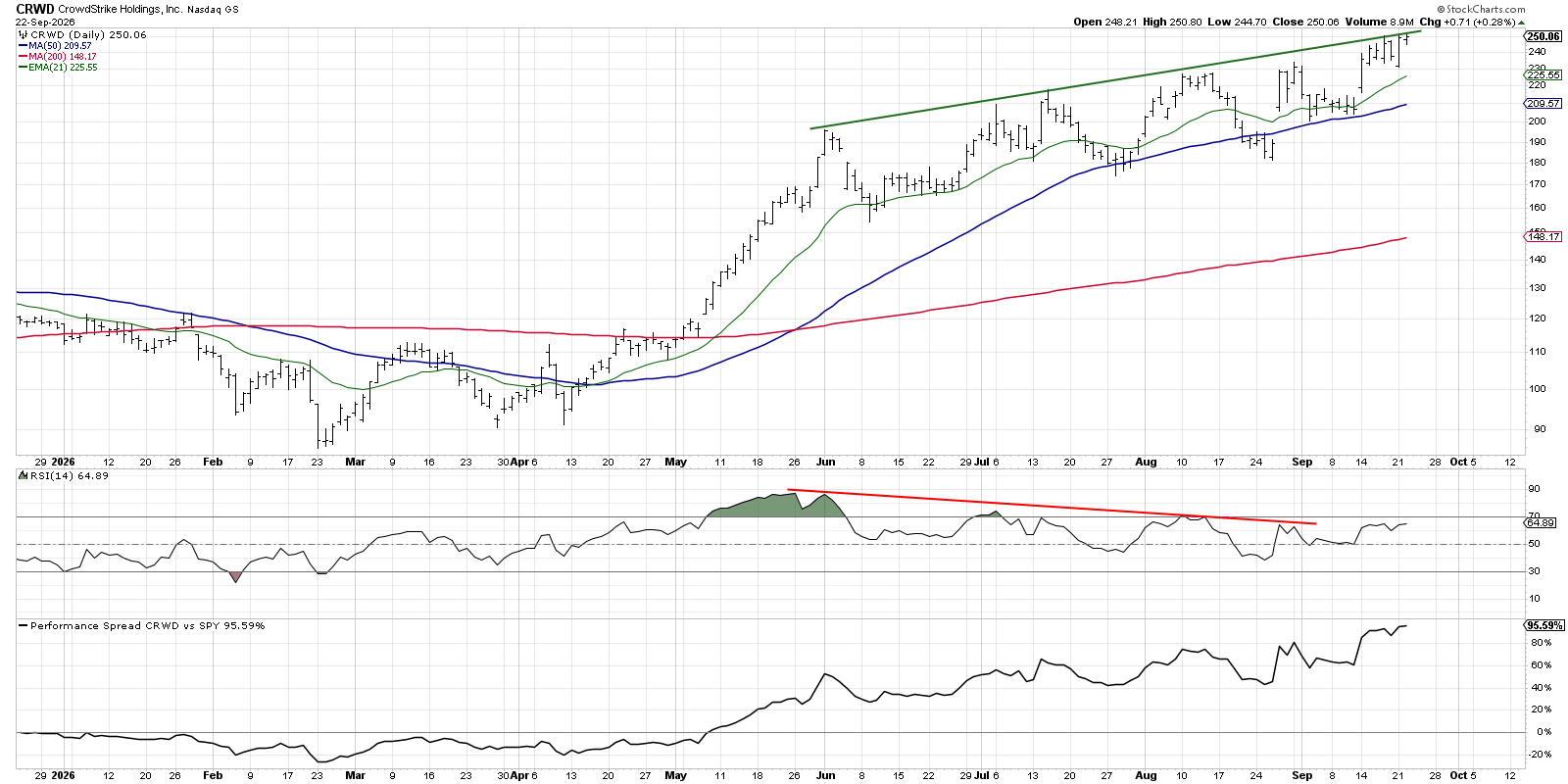
In terms of the bearish momentum divergence, this is based on the lower peaks in the RSI matched with higher highs in price.
There are two ways for this sort of divergence to resolve itself. One is that the weaker momentum drags the price lower, as an exhaustion of buyers prevents the stock from making new highs. This is what most investors expect after the initial divergence, but I have learned to be a little more patient! The other way would be that the momentum swings higher on renewed buying power, and price and RSI make a new swing high. The divergence is thus negated by a momentum improvement as opposed to new weakness in price.
Once a divergence has been established, I’ve found that, by waiting for a price breakdown, we may miss the initial rotation lower, but we’ll avoid selling way too early in case the uptrend continues. That’s what has happened with CRWD, with additional new highs just extending the divergence pattern.
As long as the price remains above upward-sloping moving averages, I would consider the bearish momentum divergences as a red flag, but one that has not yet been validated with a price rotation. And if the RSI can push further to reach above 65–70, we could see a divergence that is resolved in a bullish way for this leading cybersecurity play.
By the way, this article came from a question posed during our latest all-mailbag episode of CHART THIS with Dave Keller. Check out the latest episodes on our YouTube channel!
RR#6,
Dave
P.S. Ready to upgrade your investment process? Check out my free behavioral investing course!
David Keller, CMT
President and Chief Strategist
Sierra Alpha Research LLC
marketmisbehavior.com
https://www.youtube.com/c/MarketMisbehavior
Disclaimer: This blog is for educational purposes only and should not be construed as financial advice. The ideas and strategies should never be used without first assessing your own personal and financial situation, or without consulting a financial professional.
The author does not have a position in mentioned securities at the time of publication. Any opinions expressed herein are solely those of the author and do not in any way represent the views or opinions of any other person or entity.