Gold Is Breaking Out. Will CPI Keep the Rally Going?

Key Takeaways
- A softer inflation reading could ease Fed rate-hike fears and pressure the U.S. dollar.
- Gold and GLD have broken higher, with momentum indicators strengthening and additional upside possible.
- While the VIX is subdued, conditions can change quickly around major economic data.
A soft jobs report turned out to be good news for the stock market. The weaker data reduced the odds of a Fed rate hike in September, and Wall Street liked this shift. Equity indexes moved higher, nine of 11 S&P sectors finished in positive territory, the U.S. Dollar Index traded lower, and gold rallied.
Here’s how the three major indexes closed for the week.
- S&P 500 ($SPX): 7,757.64 (+3.58%)
- Nasdaq Composite ($COMPQ): 26,690.62 (+5.19%)
- Dow ($INDU): 54,036.93 (+2.98%)
The jobs report is only one piece of the Fed’s puzzle. Inflation is the other major factor, and it could have an even greater influence on the interest rate outlook. We will get the next inflation read on Wednesday with the release of the July CPI data. It’s also worth noting that there is still another CPI report and a nonfarm payrolls report due before the FOMC meets in September.
If inflation comes in hotter than expected on Wednesday, concerns about a Fed rate hike could resurface, and that would support the value of the U.S. dollar. A softer-than-expected inflation reading, on the other hand, could put additional pressure on the dollar. And if the dollar continues to weaken, gold prices could move higher.
The Gold Rally
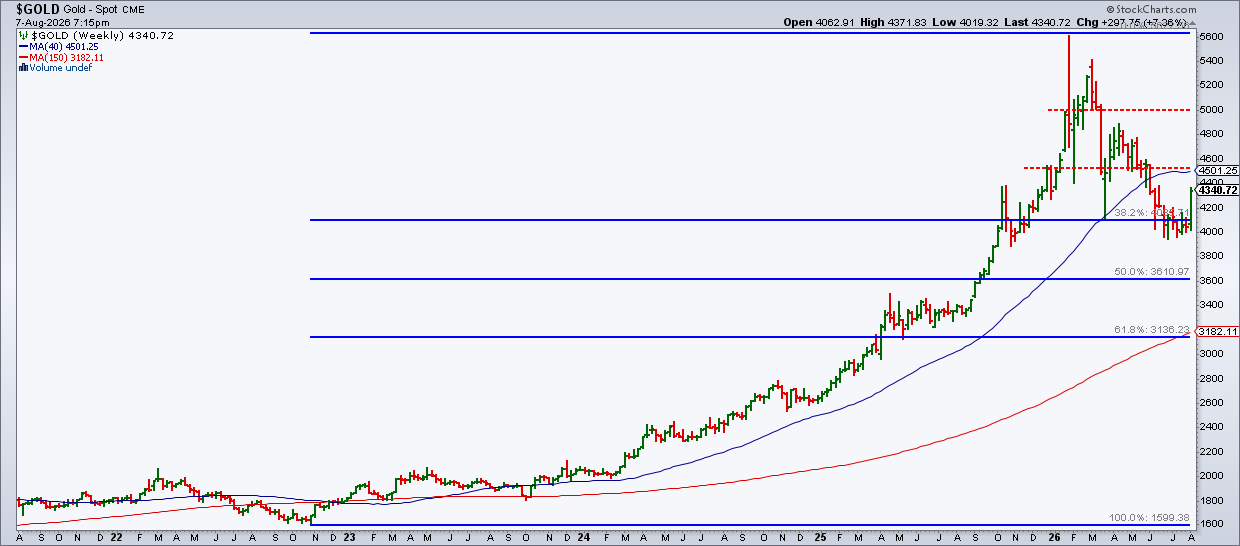
Gold prices jumped on Wednesday and finished the week up 7.39%. With gold now trading above the 38.2% Fibonacci retracement level on the weekly chart, the next area of resistance is the 40-week moving average, which lines up with the lower red horizontal line.
A soft inflation reading on Wednesday could give gold another push higher. If you want to be prepared for that possibility ahead of the CPI release, consider saving a chart of the SPDR Gold Shares (GLD) to your ChartLists.
GLD gapped higher on Wednesday, and again on Friday. The Relative Strength Index (RSI) is rising and approaching the 70 level, while the Percentage Price Oscillator (PPO) has just crossed into positive territory.
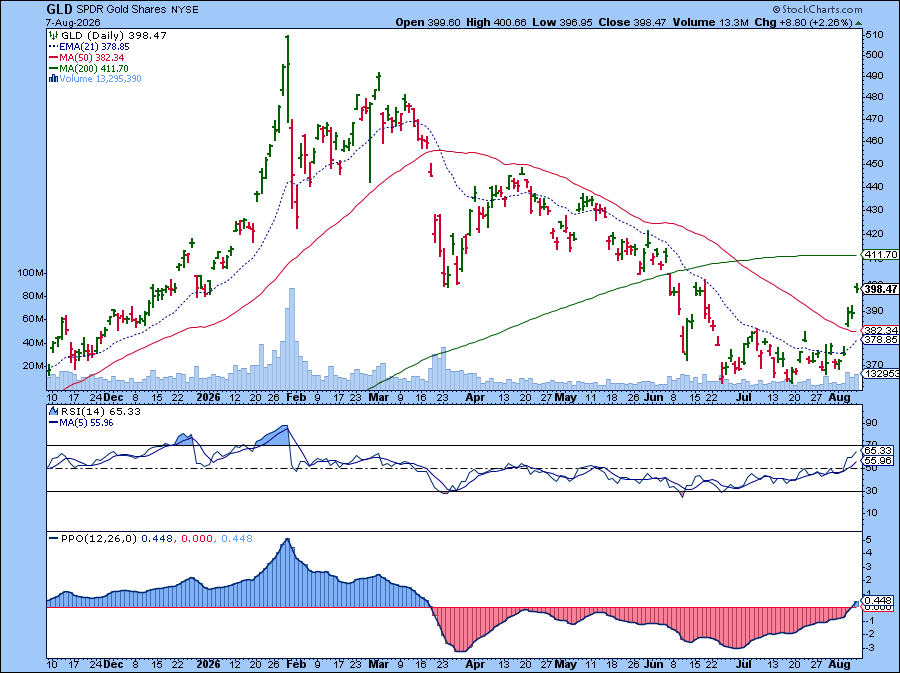
From a technical perspective, GLD appears to have room to run. It’s also thrusting out of a Bollinger BandⓇ squeeze.
And Then There’s Oil
West Texas Intermediate Crude ($WTIC) remains below $80 per barrel, but uncertainty surrounding navigation through the Strait of Hormuz continues to hang over the market.
On Wednesday, WTIC slipped below its 200-day SMA, only to reverse higher the following day. It has been relatively quiet since then. Until there’s more clarity around the situation, crude oil may continue to hover near current levels.
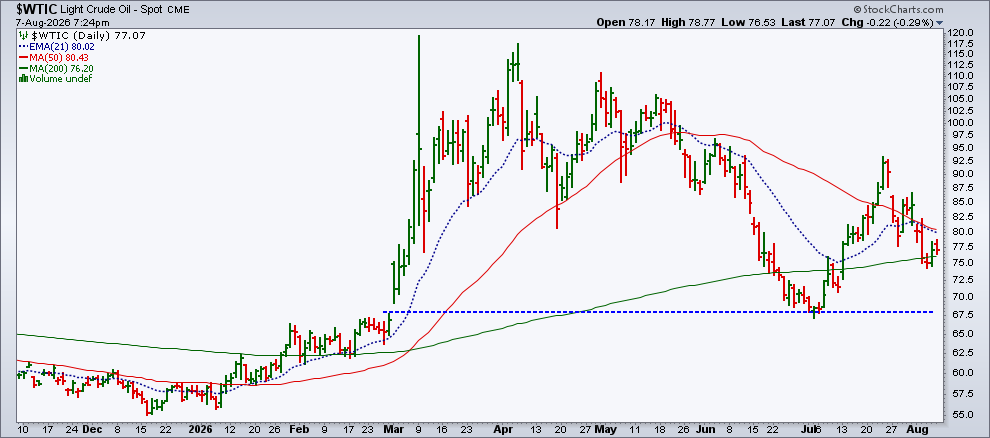
If you wish to participate in a larger move in oil, should one develop, the United States Oil Fund (USO) can serve as a proxy for crude oil prices. Consider adding the chart to your ChartLists so it’s easy to monitor.
What’s Ahead?
Next week is heavy on macroeconomic data, with inflation likely to be the stock market’s main focus. Several notable companies are also scheduled to report earnings, including CoreWeave (CRWV), Super Micro Computer (SMCI), Cisco (CSCO), and Applied Materials (AMAT).
Volatility remains relatively low, with the Cboe Volatility Index ($VIX) closing at 14.90. Barring any major market-moving headlines, volatility could stay subdued until Wednesday’s CPI release.
A headline-driven stock market can be tricky to navigate. Stocks can move sharply higher, only to give back those gains just as quickly. In this type of environment, complacency can be costly. Instead, stay alert, keep an eye on the broader trends, and be prepared to adjust your positions as the data comes in.
Ready to level up your market know-how? Head to our Articles & Videos page for fresh analysis and easy-to-learn charting tips.
Disclaimer: This blog is for educational purposes only and should not be construed as financial advice. The ideas and strategies should never be used without first assessing your own personal and financial situation, or without consulting a financial professional.