StockCharts Insider: Why I'd Never Automate Price Channels (and What I Do Instead)
Before We Dive In…
You’re probably familiar with Price Channels. Most of the trading world calls them Donchian Channels. A few decades ago, this indicator was a star in almost every trend following book. In this article, I’m going to take a more nuanced approach to this indicator, and I want you to follow me closely on this. Because I don’t necessarily buy the way the tool is generically discussed.
Don’t get me wrong. It’s a great tool with different applications. Used the right way, it generates opportunities. Used the wrong way, it’ll cut your position to ribbons. The internet will give you plenty of articles on how price channels can be used as an automated system.
Personally, no matter how well price channel strategies backtest, I’d never automate them as a set-and-forget system. There’s a smarter way to go about it—as a tool and regime filter rather than an all-encompassing system. How so? Let’s dive in.
Automation and the Time/Price Correction Trap
If you go scouring the internet, you'll find that almost all articles on Donchian Channels address the high-drawdowns, but often as a side-note to the promise of even higher returns. That is, if you, or your trading account, can tolerate the losses in between.
Time correction is a big issue. Prices will go back and forth. But the movements are in ranges, not levels. Price channels are specific levels, not ranges. Price corrections are steeper and more volatile. Some justify selling; others don’t, depending on the context and your strategy. We’ll look at both.
In the case of time corrections, you’ll get stopped out very easily when nothing major is happening. All it takes is a little choppiness. Now, if your system is always in the market, meaning it would take a short position immediately upon exiting a long one, you’re in even bigger trouble, and for no justifiable reason. In the case of price corrections, unless you’re doing the thinking yourself, you may miss out on opportunities when the context supports adding to your positions.
The Drawbacks of Automating a Price Channel Strategy
One caveat: I'm assuming an intermediate to longer-term time horizon here, not a short-term swing.
Let’s start with this chart of Micron Technology, Inc. (MU). Notice how it's a clear and ideal trend. Suppose we automated this with a 20-period price channel, buying when price exceeds the upper channel and selling (or selling short) when price exceeds the lower channel.
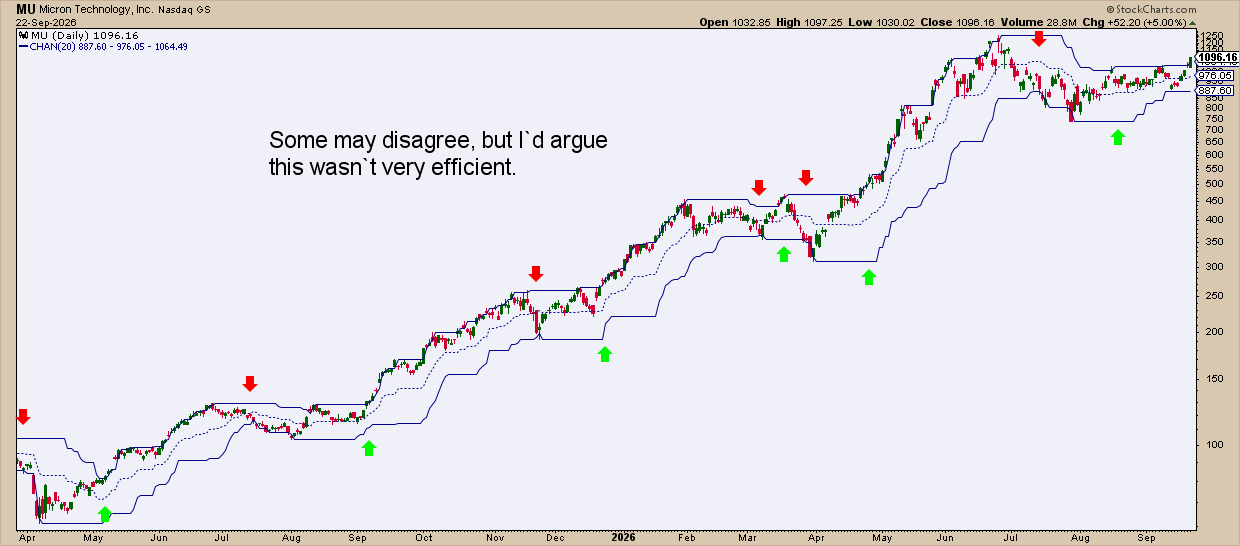
See all those entries and exits? Maybe the channels were “protecting profits”, as many system vendors would argue. But look at it. It’s been trending upward for almost the entire year. I’d argue that many of the trades were unnecessary and inefficient.
Assuming that to be the case, what did the system miss?
What the System Couldn’t Understand
Let’s look at those trade executions and the context the system missed.
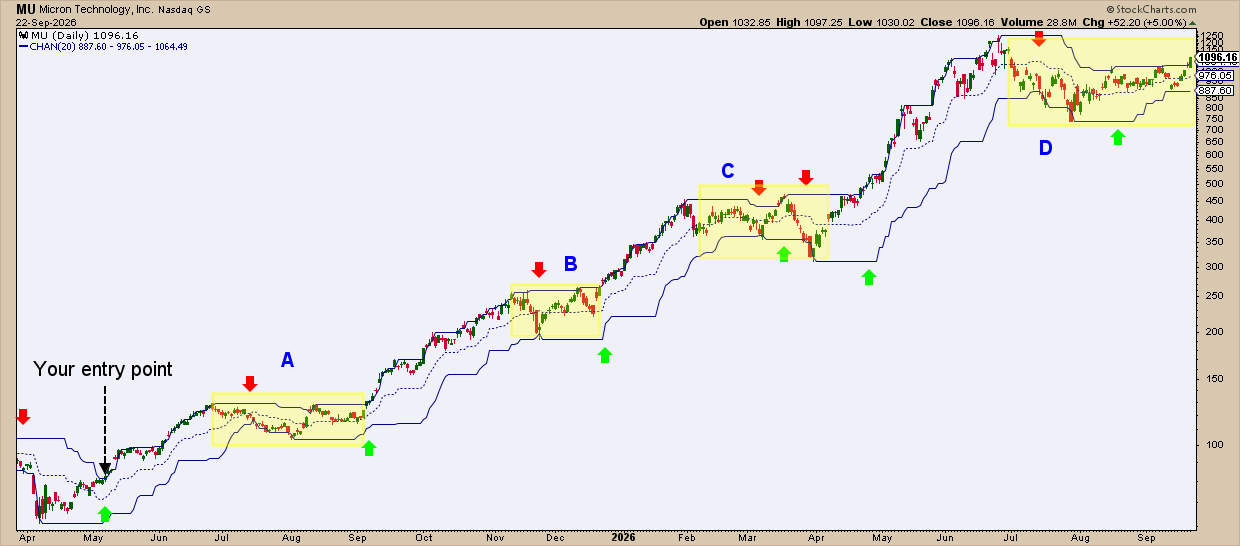
The price channel signaled a “sell” signal based on these conditions:
A - Time Correction: This was a classic sell-the-news pause. MU’s revenue beat expectations, but the prior run was exponential. Bullish investors needed time to digest all of that before jumping (back) in. The buy signal was good for new positions. The sell signal was unnecessary.
B - Time Correction: The pause was pure consolidation, not deterioration. It was likely driven by valuation anxieties and some macro-sector rotation concerns ahead of MU’s December 17 Fiscal Q1 earnings report.
C - Time and Price Correction: MU started getting wobbly in February ahead of earnings in March that turned out to be a blowout. Yet the conference call with analysts spooked investors, and from there came the profit-taking. MU saw a few dips leading to a bigger drop. If you sold here, that was understandable. But institutional investors saw it as an opportunity. A handoff from smaller hands to big hands. And that’s exactly what happened.
D - The Open Question: This brings us to the price correction at the time of writing. Economically and geopolitically, there’s lots of stuff going on. Much of it is not only highly uncertain, but extreme. Did it justify the exit signal in July? Possibly. But it depends on your strategy and time horizon.
Price Channels as a Regime Filter
As an execution signal, price channels are an excellent way to find breakouts. That’s what they’re designed to do. But you can also look at it as a regime filter. In this case, you’d combine it with other indicators to gauge trend, momentum, or anything else.
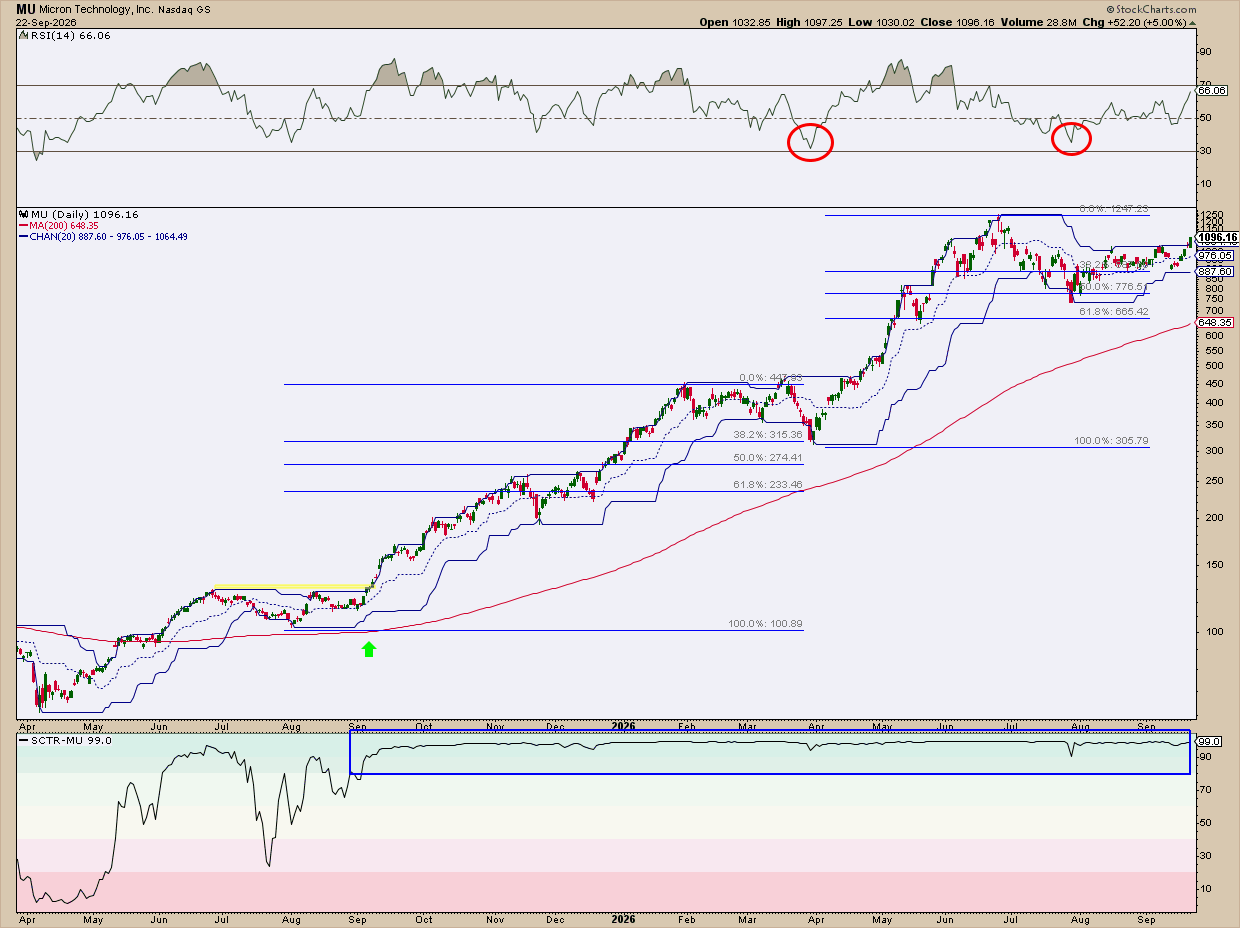
Comparing this scenario to the last, your entry signal would be in September rather than in May. Why? Because MU has had time to base above the 200-day Simple Moving Average (SMA). Would you have sold during the subsequent corrections? Well, if you were approaching this from a longer-term perspective, there are plenty of reasons not to have sold:
- The StockCharts Technical Rank (SCTR) was at a consistent skyhigh reading, indicating extremely strong technical conditions.
- If you were using the 200-day SMA as an exit point, price remained well above it.
- If you were using Fibonacci Retracements for stop placement or new position entries, price stayed well above the 61.8% line.
- Sure, the Relative Strength Index (RSI) dipped below its bullish range a few times, as highlighted by the red circles, but, overall, the stock was sound from a technical and fundamental perspective.
Using price channels as not only an execution tool but mainly a regime filter gives you an entirely different perspective and an entirely different trade.
Insider Tip #1: Be the Human in the Loop.
A mechanical system can execute a rule. It can't tell a healthy consolidation from real deterioration. The judgment call is yours to make. Always be the human in the loop.
Insider Tip #2: Don't Let the Machine Train You.
The machine can't match the wisdom and instinct behind your judgments. That’s not license to adjust your judgment to the machine. And yet that's exactly what a lot of automated-system traders end up doing: they stop questioning the underlying premise of the signal they’re following.
When it comes to price channels, it’s an effective tool. Sure, it works well systematized, but only as a component within a broader and more organic way of thinking.
And That’s a Wrap
Price channels are great at one thing: flagging when something happens. A breakout, a breakdown, it’ll catch them and fire a signal. But they can’t tell you if it means anything. That's your job. You're the human in the loop. The one who asks “okay, but why” instead of just allowing the signal to trigger a buy or sell. Overall, price channels are great execution tools and regime filters. But using them well demands a couple of things: that you pay attention, keep thinking, and stay in control of the trade.