StockCharts Insider: Why Position Sizing Sometimes Matters More Than Stock Picking
Before We Dive In…
You invested a lot of money into a bad stock, and you realized it too late. It plunged, and you've taken a huge loss. So, later, you buy a sizable position in a much stronger company. It pulls back, as all stocks do. You take another huge loss. Two stocks, completely different growth prospects, yet the same outcome.
You see, many less-experienced investors think in shares. “How many should I buy?” Seasoned investors think in terms of distance. More specifically, the distance between stop-loss and entry. Not because they avoid wide distances, but because that distance determines the amount of money they allocate to a single position—aka, their position size.
The Real Risk Isn’t Always the Stock—It’s the Size
The biggest mistake is to decide on your position size first without calculating the space between entry and stop. This is where you risk losing big or winning too small.
Here’s a better approach:
- Identify the setup
- Determine where your trade thesis fails (this is where you place your stop-loss)
- Measure the distance to invalidation
- Size your position LAST
That gap between entry and stop-loss decides your ideal exposure.
Why Charts Matter More Than Your Stock Pick
The quality of your stock pick matters, of course. But you can have a great pick and still wreck your trade.
Your advantage comes from contextualizing the price action and choosing intelligent stop locations. This means you should identify structural support and resistance. Also, be sure to assess the stock’s volatility (true range, not just the beta profile).
There are several ways to do this using a chart and indicators. Here are a few to consider:
- Swing low support (and swing high resistance) levels
- 200-day simple moving average (SMA)
- Previous breakout retest zones
- Average True Range (ATR) readings
- Price channel boundaries
- Ichimoku Cloud ranges
- Fibonacci retracements
If you can clearly see the structure, then you’re ready to do the most important work.
Three Numbers Every Trader and Investor Should Know
1 - Risk Per Trade
How much total capital are you willing to risk on a single position? 1%, 2%, or more? Let’s say your total capital is $50,000 and don’t want to risk more than 2%. In that case, your maximum risk per trade is $1,000.
2 - Risk Per Share
The distance between your entry price and your stop-loss is your risk per share. Suppose the entry price is $100 and your stop loss is placed at $95. Your risk per share is $5 ($100 - $95 = $5).
3 - Position Size
Once you know your risk per trade and risk per share, it’s time to calculate your position size.
Let’s recap:
- Risk per trade = $1,000
- Risk per share = $5
Divide your risk per trade by the risk per share, and it'll give you the number of shares to buy: 1000 ÷ 5 = 200 shares.
So now you know that if you’re wrong, the most you can lose is $1,000, plus any commissions and fees for your trade. The positive news is that this transforms position sizing from emotion or making a mere guess to a deliberate and strategic process.
Here’s a real-world example using Monster Beverage Corp. (MNST).
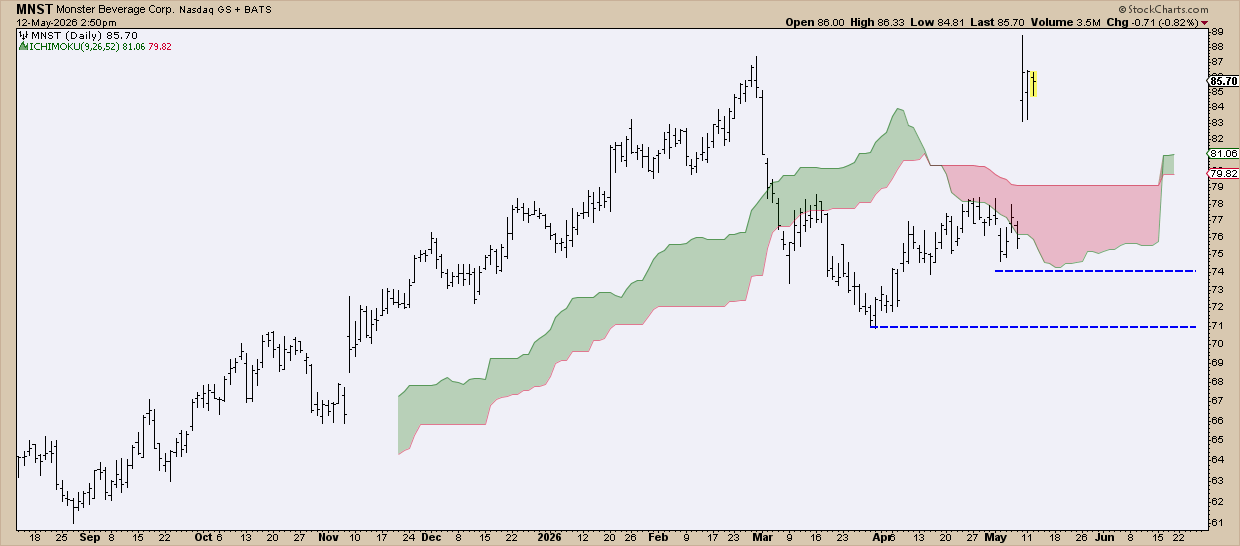
Suppose you want to jump in now, at $86. It’s not ideal, but you believe it may not dip much further (that, or you’re just impatient). You have $50,000 in your account and want to risk no more than 1%. That’s $500.
- If you choose the upper range for your stop-loss at $74—a per share risk of $12—you have to limit your position to 41 shares.
- If you choose the lower support level of $71—a per share risk of $15—you have to cap your position at 33 shares.
In either case, if your trade fails, you lose around 1%, or approximately $500. The point is that your entire trade setup is controlled. Including your potential losses.
Volatility Changes Everything
A quick diversion. If you’ve ever traded futures, you know that the e-mini Russell 2000 is far “shakier” than the e-mini S&P 500. Keep your stops too tight, you’ll get stopped out a lot. The same can be said about forex. GBP/JPY volatility can be far more unsettling than the EUR/USD.
The point is to carefully consider volatility. You do that by looking at a chart. Take a look at the NVIDIA Corp. (NVDA) chart below.
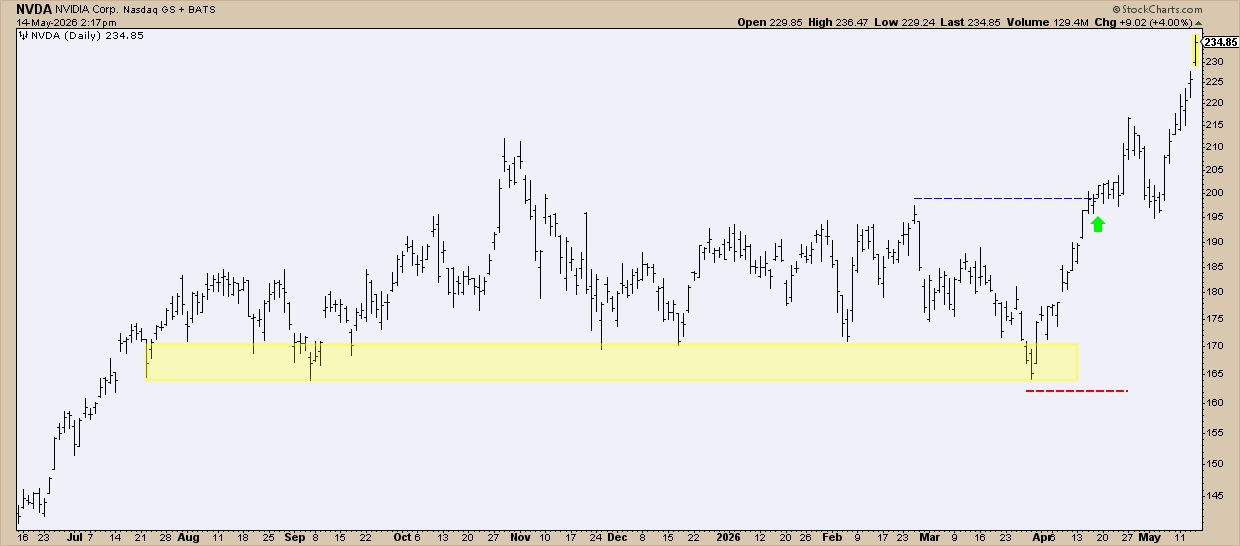
Suppose you bought the breakout at $200 (see blue dotted line). Where might you have placed your stop-loss? You probably would have avoided $165 to $172. If the breakout fails, that range is likely to get tested. Price has been testing that range for 9 months.
You’d need a much deeper stop. $162 seems much safer. But it’s incredibly wide; around $38. Still, the distance doesn’t matter as much as the position size.
Let’s assume the same account size as before, around $50k. You want to risk 2%, or $1,000 and no more. That limits you to 13 shares. Not much of a position, but you can add to it later, once the initial trade proves profitable and you can move your stop-loss to a profitable position.
Insider Tip #1: Oversizing distorts your ability to read charts. The market is a place to calculate, not psychologize. When a position is too large, it’s hard to analyze or manage a position objectively. Fear gets intense. Every pullback feels like a catastrophe. Support feels weak, even when it's not. You’re no longer thinking rationally. This is preventable. Size your positions the right way.
Insider Tip #2: Don’t confuse conviction with size. A fund manager says “we have a huge position in that trade.” Maybe it’s a gigantic position. Or a moderately-large position. But chances, that size falls within a risk framework. In other words, large doesn’t mean reckless. Some investors or financiers will risk all their capital. Every now and then we hear about the big wins and losses. Most disappear quietly after blowing up. They get taken out of the market. The lesson: you can have strong conviction and even a big position, but that position should be a well-calculated risk, not a gamble. Hence, position sizing. Some of the worst losses occur when you allow conviction to override structure.
Insider Tip #3: Proper sizing helps you survive market (and emotional) volatility. Is the potential stop-loss level too far? Or is it too close, and you’re worried about getting stopped out? In either case, place your stops where you think they’ll work. Just adjust your position.
Not only will good position sizing let you manage your trade better, it also works like “emotional shock absorption.” Why worry about these things unnecessarily when you should be focusing on your trade? Strong position sizing doesn’t eliminate losses. But it helps you avoid a “game over” scenario.
And That’s a Wrap…
The distance between entry and stop-loss quietly controls almost everything—position size, emotional pressure, reward-to-risk calculations, and, ultimately, your survivability and success. That’s why it’s sometimes more important than your actual stock pick. Success isn’t always determined by strong stock picks. It’s determined by your risk structure. And that’s your Insider lesson for the day.