This is How Market Bottoms Form
In everyday stock market action, if you want to buy a stock and there's no one on the other side of the trade to sell, a market maker steps in to provide liquidity. If you place a market order, you're at the mercy of the market maker as to what price that trade fills. But your stock will sell.
When the stock market panics and the Cboe Volatility Index ($VIX) spikes to 20, 30, 40, or even higher, it becomes a "market maker on vacation" type of environment. Selling escalates rapidly and irrational or impulsive market behavior begins. It doesn't happen often, but when it does, it gets scary.
That's what the end of last week was... scary.
Price support levels mean nothing when selling becomes impulsive and irrational. As a trader, I rely on price support, so high VIX readings generally move me to the sidelines. I'd much rather sit in cash and protect my capital than try to pick the right side of an emotional trade, which is essentially flipping a coin. Ultimately, the VIX will top and create the buying opportunity of a lifetime. The question, however, is how high the VIX will go before that top (and market bottom) forms.
It's important to learn from history, so that when irrational periods like this one begin, we're somewhat prepared. We'll never be totally prepared, but understanding what makes these environments go away is important to (1) protecting capital, and (2) becoming more confident in terms of when to put money to work.
Let's take a trip down memory lane.
The financial crisis of 2008–2009 was a bit different than today's volatile environment, because it clearly took place within a secular, or long-term, bear market, where panic selling led to more panic selling. Still, a high VIX and a high 5-day moving average of equity-only put call readings marked major bottoms. Check out this chart of the VIX during the 2008–2009 financial crisis.
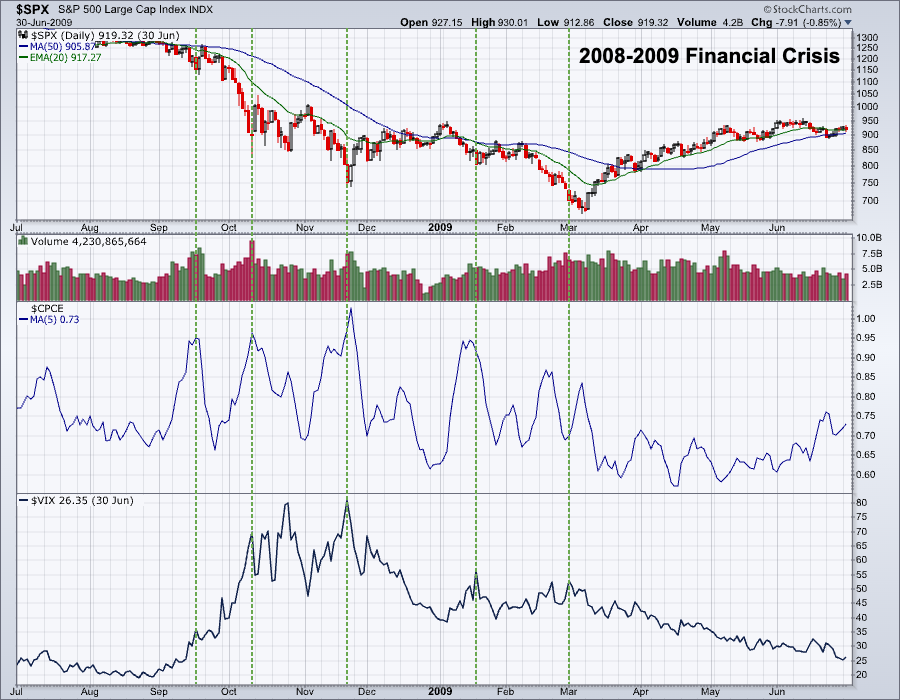
The first big drop in the S&P 500 resulted in the VIX climbing to 35 and the 5-day CPCE touching 0.95 (anything above 0.75 is typical to help mark bottoms of market declines). Had this period been part of a secular bull market, rather than a secular bear market, I would have expected this decline to represent the entirety of the weakness. The VIX level of 35 would have likely marked a bottom.
Next up is the last bear market that occurred during the normally bullish Q4, back in 2018 during the US-China trade dispute.
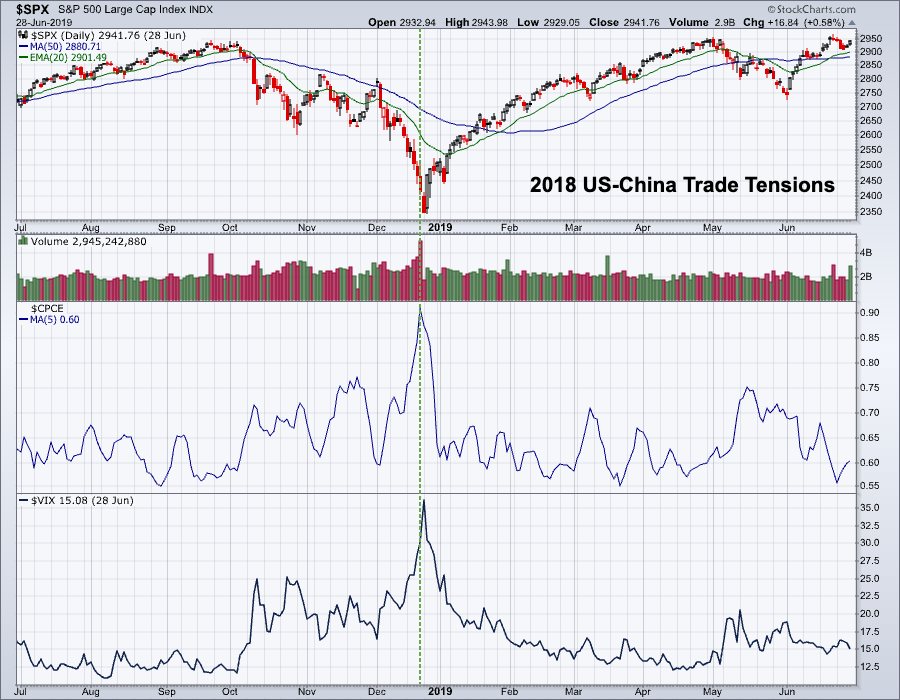
This is more typical of a cyclical bear market within a secular bull market. It's usually quick and of the "V" bottom variety. In this case, the S&P 500 tumbled rapidly, while the VIX again spiked to the 35 area and the 5-day CPCE reached 0.90. Within four months, the S&P 500 returned to its pre-cyclical bear market high.
One last period to look at is the 2025 and 2026 Q1–Q2 lows.
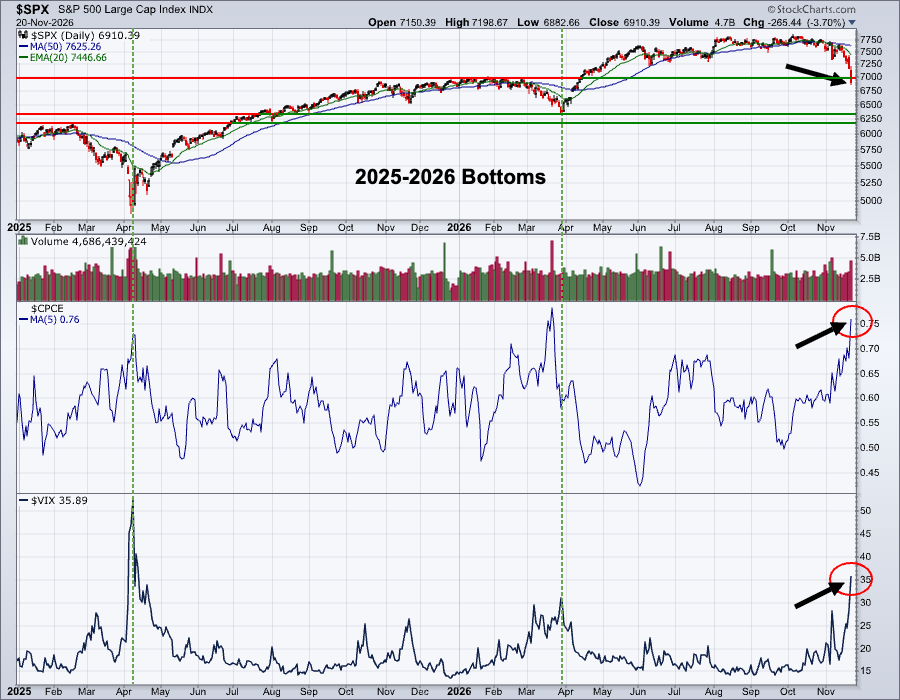
These, like 2018, were "V"-bottom recoveries. The VIX jumped above 50 in 2025 and moved through 30. In both instances, the 5-day CPCE climbed into the 0.70s.
So where are we heading now?
That's a great question, but the skyrocketing VIX makes the stock market very unpredictable. Getting in too early could be extremely painful in the short term, as the VIX has shown that it can climb to 50 or higher. If it does, the S&P 500 could fall back to its 2026 low near 6300, or even retest its earlier breakout at 6144. That would still represent another 10% selloff, if that were to occur.
The flip side, however, is waiting to see if you can enter at those depressed levels. But history tells us that many prior selloffs have found bottoms with the VIX at, or even below, the current VIX reading of 35. So, what do you do?
Personally, I don't like trading individual stocks in such a volatile environment. If my timing is wrong with individual stocks, the losses can be catastrophic. Instead, what has worked well for me in the past is to spread my money around in the various index ETFs (DIA, SPY, QQQ, IWM), entering in stages. I won't enter at the perfect time with all my money, but it's a disciplined and diversified way to enter stocks during a period of irrational weakness.
Time To Prepare For 2027
At some point, the market will be healthier and a better opportunity to trade profitably will return. In the meantime, now is a great time to improve your planning process and trading strategies. In response to our EarningsBeats.com member requests, we will host a FREE Live Workshop that addresses both of these topics, including the most popular question, "When do I sell?"
For more information on this event and to register to save your seat, simply CLICK HERE.
Happy trading!
Tom